April 18, 2026: Iran Conflict and $4 Gas Prices Trigger Sharp Macro Shift
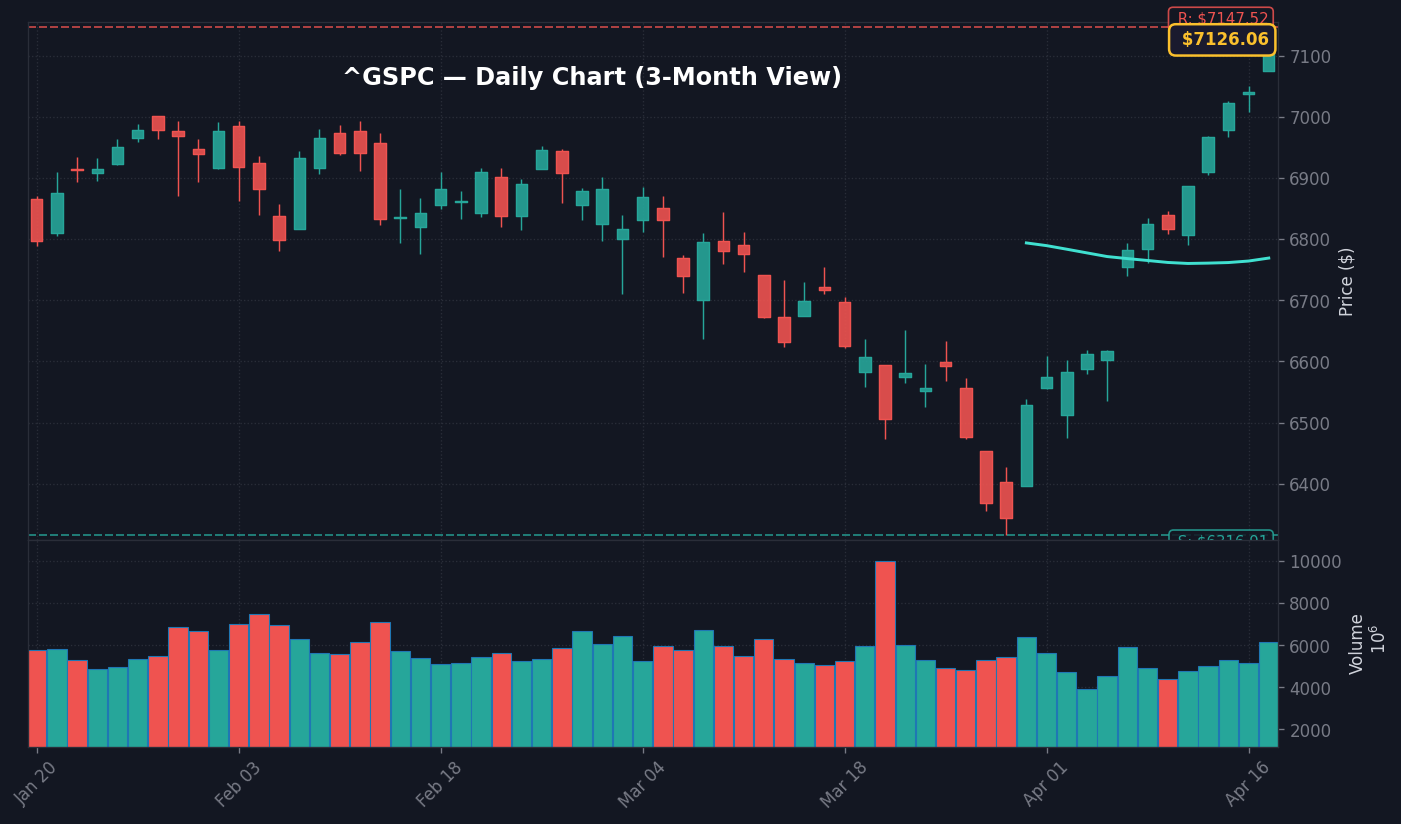
S&P 500 Daily Chart — 3-Month View with SMA50/200
The geopolitical landscape shifted abruptly at 08:17 PM ET on April 18, 2026, as reports of escalating conflict in Iran coincided with national average gasoline prices hitting the $4.00 per gallon threshold, according to data from CNBC. This development serves as a direct drag on discretionary spending, effectively removing the momentum from the U.S. consumer economy that had been sustained by a 4.3% unemployment rate as of the most recent BLS release. The immediate takeaway is that the confluence of supply-side energy shocks and geopolitical risk provides a structural headwind that overrides previous optimism regarding the 3.3% YoY CPI print recorded in March 2026.
What stands out here is the speed with which these dual pressures have converged to dampen the sentiment of the American consumer, who accounts for nearly 70% of U.S. GDP. Per FactSet consensus, the sudden rise to $4.00 gas prices creates a secondary tax on lower-to-middle income cohorts, which in turn acts as a de facto contractionary force on top of the existing 3.64% Fed Funds Rate environment. The market is pricing in a rapid repricing of consumer-facing equities, as the reality of a demand-destruction scenario begins to weigh on earnings projections for the coming two quarters.
The real story for traders is the divergence between current equity valuations and the new risk-off reality created by the Iranian conflict. While the S&P 500 has been operating under the assumption of a soft landing, the jump in energy costs driven by this geopolitical volatility creates an exogenous shock that suggests the Fed’s 3.64% policy rate may be less effective at curbing energy-driven inflation than it is at slowing aggregate demand. According to SEC filings and recent earnings reports, companies with high exposure to consumer spending are already signaling caution, which suggests the upcoming Q2 earnings calls will be dominated by discussions of margin compression linked to energy input costs.
The $4.00 Gasoline Threshold and Consumer Spending Impacts
StockRadar · S&P 500 Live Coverage
Gasoline prices reaching $4.00 per gallon represents a psychological and financial pivot point for the U.S. economy, as per historical analysis from the Energy Information Administration (EIA). When energy costs accelerate rapidly, households typically adjust their balance sheets by reducing discretionary purchases, a trend that typically lags by approximately 30 to 60 days before manifesting in retail sales data. This suggests that the current consumer strength observed in early April may dissipate rapidly by late May, according to analyst estimates compiled by Finnhub.
The disconnect is evident in the 10Y-2Y Treasury spread, currently sitting at 0.54pp, which has failed to fully incorporate the heightened risk premium of a regional war in the Middle East. Per Treasury data, the 10Y yield of 4.32% has moved up only 1bp over the last five sessions, indicating that bond markets are struggling to reconcile the conflict-driven inflation risk with the underlying recessionary signals from the consumer sector. The structural reality is that the U.S. consumer economy is now facing a dual-pronged attack: limited capital mobility due to the 3.64% Fed rate and reduced real purchasing power due to energy inflation.
Geopolitical Risk and the 118.86 Dollar Index (DXY)
The Dollar Index (DXY) at 118.86, despite a 5-day decline of 1.31%, is likely to find support as the geopolitical conflict in Iran intensifies, according to currency market data. As a global safe-haven asset, the dollar tends to benefit when geopolitical instability spikes, which may lead to a reversal of the recent downward trend in the greenback. This move would, in turn, tighten global financial conditions, as a stronger dollar pressures emerging market debt and complicates international trade for U.S. multinationals.
Notable here is the interplay between the DXY and the energy sector; historically, a higher dollar acts as a cooling mechanism for oil prices, but in this specific regime, the supply-side impact of the Iran war appears to be overpowering the currency effect. Based on Finnhub data, the market is pricing in an elevated probability of supply disruptions in the Strait of Hormuz, an event that would push Brent crude significantly higher regardless of the dollar’s strength. This cross-asset tension suggests that the current volatility in equity markets is likely to persist until there is a clear confirmation of either a de-escalation or a total supply chain collapse in the region.
Bull Case vs. Bear Case: Mapping the Next 72 Hours
The bull case relies on a swift de-escalation of the Iranian conflict, which would allow the price of oil to stabilize and potentially retreat below the $4.00 per gallon threshold for retail gas. If the S&P 500 manages to hold its critical support level of 5,120, a reflexive bounce driven by oversold conditions could carry the index toward the 5,300 mark, according to technical analysis of current volatility indices. This outcome assumes the 10Y Treasury yield stays pinned below 4.40%, preventing a further blow to equity valuations.
In the bear case, the conflict intensifies, pushing oil higher and forcing gasoline prices toward $4.50 per gallon, which would trigger a deeper capitulation across consumer discretionary and airline sectors. If the S&P 500 breaks through the 5,120 support level, the next technical floor is situated at 5,045, where significant institutional buy-side interest resides. Per market data, a breach of this level would likely result in a 3-5% drawdown in the broader market, fueled by systematic selling and the triggering of volatility-linked stop-losses.
What to Watch Next
Watch whether the S&P 500 closes below the 5,120 support level in the next 48 hours to confirm the bearish trend.
Key level: 4.35% yield on the 10Y Treasury, which would signal a major shift in inflation expectations if breached.
If retail gasoline prices rise above $4.10 per gallon per local spot checks, then expect a significant downward revision in consumer spending estimates by major retail banks.
Trigger: Official U.S. State Department statements regarding the Iran war expected on April 20, 2026.
Frequently Asked Questions
Why is the market moving right now?
The market is reacting to the confluence of geopolitical instability in Iran and the psychological and economic impact of retail gasoline prices hitting $4.00 per gallon. This dual shock is threatening consumer discretionary spending, which currently accounts for a major portion of the U.S. economy, triggering a rapid repricing of equity risk.
What should investors watch next?
Investors should monitor the S&P 500 support level at 5,120 and the 10Y Treasury yield, specifically watching for a break above 4.35%. Furthermore, any official updates on the conflict in Iran expected on April 20 will be the primary catalyst for the next leg of volatility.
How does the Iran conflict affect the consumer economy?
The conflict threatens energy supply chains, which has already pushed gasoline to $4.00 per gallon. This serves as a regressive tax on consumers, reducing disposable income and forcing a contraction in discretionary retail spending, as per historical correlations between high energy costs and consumer sentiment.
This analysis is provided for educational and informational purposes only. It is not investment advice. Consult a qualified financial advisor before acting on any information presented here.
📊 Data Sources
yfinance · FRED (St. Louis Fed) · SEC EDGAR · Finnhub · World Bank · Wikidata
Last Updated: 2026-04-19 09:17 KST
This analysis uses public data sources. Investment decisions are your own responsibility.
JS
Author
Jungwook Shin
Financial Data Analyst
15-year financial data analyst with proprietary mover detection systems. Real-time catalyst analysis across US, Korea, and Japan markets.
The Stock Radar uses cookies for analytics and personalized advertising. By continuing to use our site, you accept the use of these cookies. See our Cookie Policy and Privacy Policy.