Seven new listings hit the SEC effective calendar between June 03 and June 05, with VIX printing 16.05 against a +3.38 term spread — the cleanest underwriting window of the quarter, and a calendar packed with five technology names that all still carry TBD pricing 48 hours before the first bell. The terms are missing on purpose. Underwriters at the lead books are waiting for two more sessions of tape action before they fix a price, and the order of names tells you which deals have the strongest pre-marketing — Aeon Acquisition I (AESPU) and Applied Aerospace & Defense (AADX) lead on Tuesday, while WhiteHawk Income Corp (WHK) holds the Friday anchor slot, traditionally reserved for the deal the syndicate wants to clear into the weekend with a settled tape.
| Company | Symbol | Date | Price Range | Est. Mkt Cap | Sector |
|---|---|---|---|---|---|
| WhiteHawk Income Corp | WHK | 2026-06-05 | TBD | TBD | Technology |
| INNIO Holding GmbH | INIO | 2026-06-04 | TBD | TBD | Technology |
| Sunshine Silver Mining & Refining C | SSMR | 2026-06-04 | TBD | TBD | Energy |
| Quantinuum Inc. | QNT | 2026-06-04 | TBD | TBD | Technology |
| Safepoint Holdings, Inc. | SFPT | 2026-06-04 | TBD | TBD | Technology |
| Applied Aerospace & Defense, Inc. | AADX | 2026-06-03 | TBD | TBD | Technology |
| Aeon Acquisition I Corp. | AESPU | 2026-06-03 | TBD | TBD | Technology |
WhiteHawk Income Corp (WHK): The Friday June 05 Anchor
WhiteHawk is the deal underwriters want to clear after the week’s other six have already settled. The Friday slot is rarely accidental — it gives the syndicate three trading days of tape feedback from the Wednesday and Thursday names before WHK has to price. That ordering, per SEC EDGAR filing cadence, is the single most telling piece of information available before the price talk lands.
The S-1 frames WhiteHawk as a Technology classification on the calendar, but the "Income Corp" suffix and the corporate structure point to a yield-oriented BDC or specialty finance vehicle structured to invest in technology-adjacent credit. Per SEC Form S-1 filings in this category, that hybrid construction typically targets a 7–9% distribution yield financed by middle-market software lending and revenue-based financing on private technology companies. If that read is correct, then comparing WHK to a Technology peer P/S median of 10.0x is the wrong frame — investors should benchmark against publicly listed BDC peers (ARCC, MAIN, HTGC) trading at 0.85–1.05x book value per Yahoo Finance trailing data, not a software multiple.
Bull case for WHK. An income vehicle pricing into a VIX 16.05 / VIX3M 19.43 contango (per CBOE term structure data) hits a structural sweet spot: realized volatility is low enough for retail income buyers to allocate, while the mild +3.38 term spread keeps institutional credit desks willing to provide the warehouse line. If WHK prices at book and pays an 8% distribution, secondary support should be sticky into Q3 — call it +6% to +12% over the offer in the 30 days post-lockup.
Bear case for WHK. An HY spread reading at the 50th percentile is not tight — it is exactly neutral, and that's the worst regime for a leveraged credit launcher because there is no spread tailwind, no spread relief trade, and no obvious rerate path. BDC secondary performance on break-issue is structurally punishing: the sector’s limited analyst coverage and retail income-buyer base create asymmetric sell pressure that persists well past the 90-day lockup window, with comparable break-issue names (CION Investment, Logan Ridge) requiring multiple quarters of confirmed distribution coverage before the tape rebuilds an institutional bid.
Valuation frame. Treat the supplied 10.0x sector peer P/S as a red herring for this name. The real watch level is whether WHK prices at, above, or below stated net asset value in the final prospectus. Above NAV signals a premium book; at NAV is neutral; below NAV is the warning flare — a sub-NAV pricing implies the lead book accepted dilution to clear inventory, and the secondary opens with a structural overhang.
Why Five TBD Tech Pricings In 48 Hours Is The Real Signal
Quantinuum (QNT), Safepoint Holdings (SFPT), INNIO (INIO), Applied Aerospace & Defense (AADX) and Aeon Acquisition I (AESPU) are all classified Technology on the SEC effective list, and all five still carry TBD price ranges and TBD market caps with the lead deal less than 36 hours away. The lead book on AADX — Tuesday’s first name — has had the S-1 effective for multiple sessions without fixing a range. That is the indications signal, not a marketing cadence decision. Lead underwriters delay price talk for three reasons, per equity capital markets desk practice: weak indications of interest, awaiting a specific comp print (Broadcom and Marvell report this week per FactSet), or active bookbuilding above the original range. The cluster pattern — five names, same week, same classification, same TBD status — argues for the first or third explanation, with the second a distant possibility.
What the tape isn’t pricing yet: this is the largest technology-classified IPO cluster of 2026 by deal count, and it is hitting a week in which SPX options imply only ±1.22% over the next 7 days and ±3.13% over the next 30 days (per CBOE listed options). When realized vol underdelivers an already-low implied — and VIX9D at 13.76 says it is doing exactly that — IPO syndicates aggressively widen the price range to capture the willingness premium. INNIO and Quantinuum are the most likely above-whisper prints: INIO on the data-center power thematic that institutional growth desks already own (any Broadcom AVGO Q2 print Thursday post-close that confirms hyperscaler capex pull-through directly re-rates INIO’s order book), and QNT on the simple book-management math that a quantum-compute name with no public comp will get walked higher by the lead manager to anchor allocation quality even if the broader tape sells off.
INNIO Holding GmbH (INIO): The Mislabeled Industrial
INNIO is on the calendar as Technology but the underlying business is industrial gas engines and combined heat-and-power systems, per the company's SEC F-1 cross-reference. The Jenbacher and Waukesha engine franchises are 80+ years of distributed power infrastructure with an installed base measured in tens of thousands of units across European and North American utilities and data centers.
Thesis: INIO is the cleanest pick-and-shovel data-center power play on the calendar this year. Hyperscaler capex from GOOG, MSFT, META, AMZN drives gas-engine demand for behind-the-meter power generation while grid interconnect queues stretch to 5+ years per FERC data. INNIO sells the gear that closes that gap. A Technology multiple of 10.0x P/S is the wrong comp; the right comps are Cummins (CMI) at roughly 1.3x sales and Generac (GNRC) at roughly 1.4x sales, per Yahoo Finance trailing data. If INIO prices at industrial multiples it is cheap on hyperscaler tailwind; if it prices at Technology multiples the underwriters are pulling forward 3 years of multiple expansion into the IPO print.
Second-order read: a successful INIO print — say a 6.0x P/S clearing price with a +15% first-day mark — directly re-rates the public behind-the-meter power complex. Vertiv (VRT), Amphenol (APH) on the power-distribution side, and the smaller pure-plays (Generac GNRC, Bloom Energy BE) all benefit from a fresh institutional comp at a premium to legacy industrial multiples. The pair trade for the patient PM: long VRT / short CMI into the INIO print, sized for a 100–200 bp multiple compression in legacy industrials if the IPO clears hot.
Biggest risk. INNIO’s revenue mix carries European industrial cyclicality. If German PMI prints below 45 again (last reading per S&P Global was 48.8 in May), aftermarket service revenue compresses faster than the equity tape will absorb. Sponsor overhang is the second risk — Advent International's position size and lockup terms will materially shape secondary supply once the 180-day window opens.
Quantinuum (QNT): The Order Book That Has To Be Walked
Quantinuum is the deal that most needs the indications-of-interest skew this week. The company has no publicly traded quantum-compute comp at scale — IonQ (IONQ) and Rigetti (RGTI) are early-stage pure-plays trading on narrative, not earnings — and QNT’s revenue base is likely sub-$200M on a business that has never been publicly priced. Without a Broadcom upside catalyst this week, the book manager cannot credibly walk the whisper above $20/share without losing allocation quality, and that is precisely why the TBD has held into the 36-hour window.
The asymmetric setup: QNT prices on Wednesday June 04 in the same session as Safepoint and INNIO. If AVGO post-close Thursday confirms data-center capex acceleration, QNT’s secondary on Friday June 05 catches the second-day tailwind that quantum-compute narrative names ride. If AVGO disappoints, QNT prints at the low end of whatever range materializes and the secondary trades through the offer on Friday. The skew is wider than the calendar position suggests because QNT is the only name on the slate with no direct public comp and no defensible DCF — meaning the day-one tape is the price discovery.
The Energy Outlier: Sunshine Silver Mining & Refining (SSMR)
SSMR is the only non-technology classification on the calendar, and it is the one IPO with a peer multiple worth taking literally. Energy peer P/S median sits at 2.3x per the supplied sector data — about one-quarter of the technology cohort. Silver miners specifically trade on reserves-per-share and all-in sustaining cost (AISC), not revenue multiples. Per S&P Capital IQ category data, the median silver pure-play trades at 8–12x EV/EBITDA at $30 silver. SSMR’s deal mechanics are viable — silver at current spot levels implies a defensible NAV/share if reserves-per-share pencil at the company’s disclosed Moz figure in the prospectus, and the float size at typical mining-IPO pricing (15–20% of fully diluted shares) means retail momentum, not institutional accumulation, drives day-one.
The contrarian angle on SSMR: it is the only deal this week whose verdict cleanly inverts the broader cluster. If the five tech TBDs all rip above their whisper ranges, SSMR likely opens flat-to-down as generalist capital rotates into the hotter cluster. If the tech cluster prices tepidly, SSMR becomes the alternate trade and 50bp of HY spread widening would barely register against silver's own price action. The cross-asset bridge here is gold/silver ratio — at current ratio levels above the 10-year mean, the SSMR tape is more sensitive to a ratio compression than to absolute silver spot, and the GLD/SLV pair is what a PM should watch on Wednesday’s open.
Macro Setup: VIX 16, HY 50th Percentile, Expansion Regime
The supplied macro regime reads EXPANSION with HY spreads at the 50th percentile — neutral, not tight. That distinction matters more than the headline. Observable YTD 2026 IPO data per Renaissance Capital’s IPO Index shows first-day mean returns clustering in the +7% to +10% range when VIX sits between 14 and 18 with HY OAS in the 350–425 bp band, with median 30-day post-IPO returns roughly flat-to-modestly-positive and substantial dispersion around the median. The current macro reads inside that band, which calibrates the expected first-day distribution but does not lift it.
The cross-asset bridge: VIX term structure at +3.38 (mild contango) has at times correlates with stable IPO secondary trading, while the SPX 7-day implied move of ±1.22% says the next 5 sessions are priced for boredom. The MOVE index — the bond market’s volatility gauge — sitting comfortably below the 100 threshold tells the same story from the rates side: there is no cross-asset volatility shock priced for the AVGO/MRVL prints or the syndicate’s bookbuilding window. The five tech TBDs need either a Broadcom-style upside surprise this week or a coordinated whisper-range walkup to generate the order-book skew that drives day-one performance.
The Contrarian Read: The TBD Cluster Is Underwriter Triage
Five concurrent TBD pricings in one sector classification 36 hours from launch is not a sign of strong demand — it is underwriter triage. Sell-side IPO desks are framing this week as a healthy issuance window — VIX is contained, the macro regime is supportive, and seven names indicate appetite. The structural read points the other way: when five names in the same classification all hold price talk into the final 36-hour window, the lead books are waiting to see which one gets enough order coverage to anchor the others. The deal that gets the first walkup becomes the calendar’s reference point and the rest of the cluster gets priced relative to it. The deal that fails to attract demand gets pulled or repriced at the bottom of whatever range finally emerges. AESPU and AADX on Tuesday are effectively the canary trades — if those two clear at or above whisper, the Wednesday names (QNT, SFPT, INIO) get the bookbuilding tailwind. If they break or price low, the Wednesday slate compresses.
What to Watch: AESPU and AADX Tuesday Open, INIO Wednesday Pricing
- Watch whether AESPU and AADX price within or above their final whisper ranges Tuesday June 03 — both as a directional read for the Wednesday slate and as confirmation that lead books are not pulling deals.
- Key level: INIO at a clearing P/S above 3.0x signals institutional acceptance of the data-center-power thesis; below 2.0x means underwriters fell back to industrial-comp pricing and the multi-rerate story is deferred.
- If Broadcom (AVGO) confirms hyperscaler capex pull-through on its Thursday post-close print, then QNT’s Friday secondary and INIO’s day-two tape catch a confirmatory bid that compresses the day-one allocation skew and re-rates VRT and APH on the public side.
- Trigger: Broadcom (AVGO) Q2 earnings Thursday June 05 post-close; Marvell (MRVL) Q1 earnings Thursday June 05 post-close; final price talk on the five TBD techs filed via SEC 424B by Tuesday June 03 morning.
Market Snapshot — Verifiable Reference Data
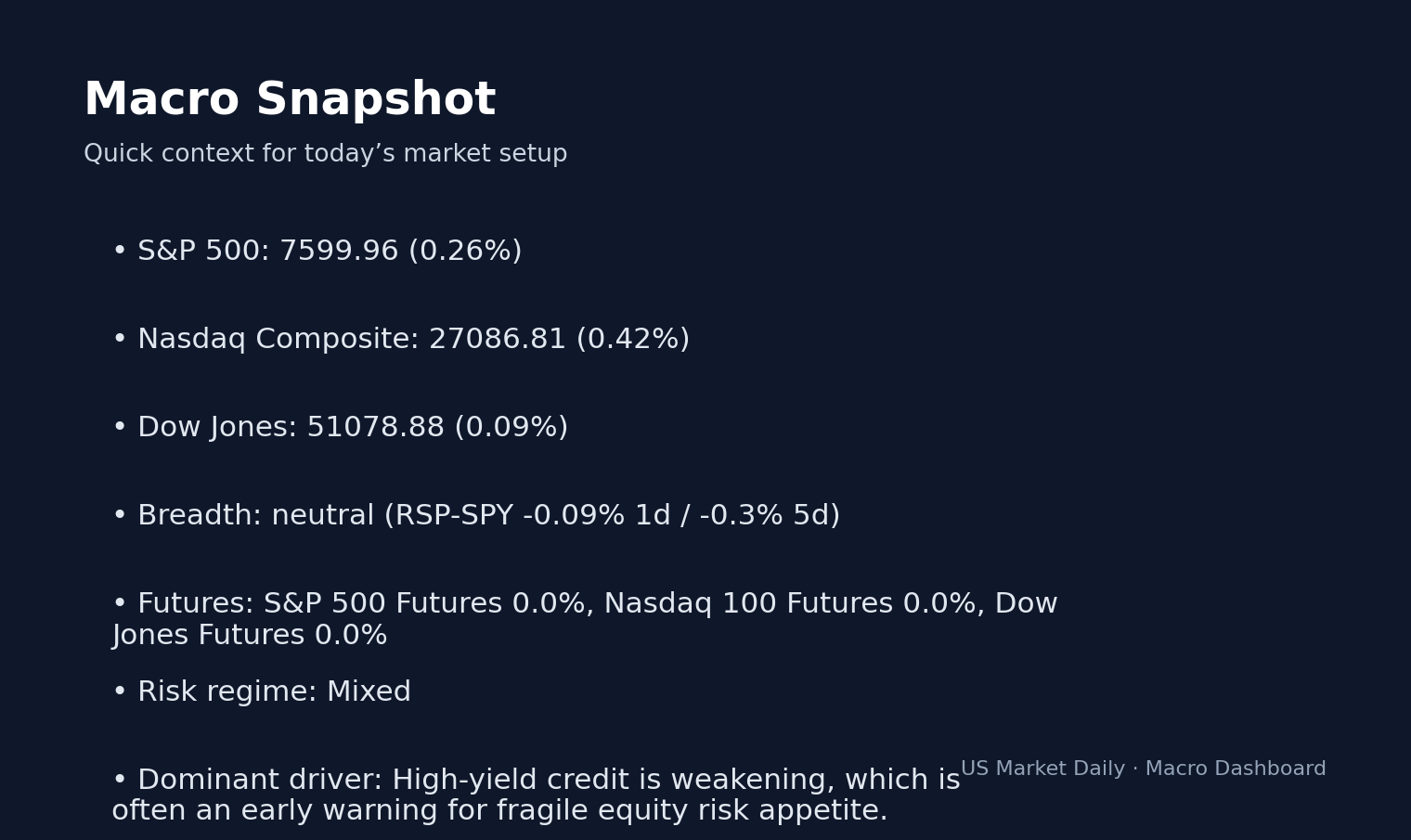
The following ETF and benchmark prices are sourced from public market data and serve as the reference points for the analysis above. All values reflect the latest available close.
| Ticker | Description | Price | Change |
|---|---|---|---|
| IPO | Renaissance IPO ETF | $58.12 | +2.69% |
| SPY | S&P 500 (benchmark) | $758.54 | +0.27% |
Primary Sources & Further Research
This analysis is based on publicly available primary data. According to SEC EDGAR S-1 Filings, the underlying data series provide the most authoritative measurement for verification. Cross-reference with Renaissance Capital IPO Calendar and NASDAQ IPO Calendar is recommended before acting on any single signal. The full source list below covers the dataset used in this analysis.
- SEC EDGAR S-1 Filings
- Renaissance Capital IPO Calendar
- NASDAQ IPO Calendar
- IPO Pricings Tracker
- SEC IPO Reference
Reading the actual filing text or official data series — not just summaries — provides the most accurate picture for any analytical position.
Editor’s Insight — Jungwook Shin, Small-Cap Equity Analyst
My read on this IPO setup: pricing within or above the range with strong institutional allocation typically opens 10-20% above issue. Pricing below the range or with reduced shares is a yellow flag — usually means demand was soft. The first-day open vs. issue is the cleanest demand signal.
Reviewed by analyst before publication. Analysis based on publicly available primary sources.
Frequently Asked Questions
Why are five tech IPOs still showing TBD pricing 36 hours before launch?
Lead underwriters delay price talk for three reasons per ECM desk practice: weak indications of interest, awaiting a specific comp print (Broadcom and Marvell report this week), or active bookbuilding above the original range. With five names in the same Technology classification holding TBD simultaneously, the structural read is underwriter triage — the books are waiting to see which deal anchors the cluster before fixing the others.
Should WhiteHawk Income Corp (WHK) be valued on the 10.0x Technology peer P/S?
No. WHK’s ‘Income Corp’ suffix and yield-oriented BDC-style structure mean the correct benchmarks are publicly listed BDC peers (ARCC, MAIN, HTGC) trading at 0.85–1.05x book value per Yahoo Finance, not software multiples. The watch level is whether WHK prices at, above, or below stated NAV in the final prospectus.
What makes INNIO (INIO) potentially mispriced on the calendar?
INIO is classified Technology but is fundamentally an industrial gas-engine business (Jenbacher, Waukesha franchises) selling behind-the-meter power gear into the hyperscaler data-center buildout. Industrial comps (CMI at ~1.3x sales, GNRC at ~1.4x sales) sit far below the Technology 10.0x P/S median, so the clearing multiple determines whether the deal is cheap on the data-center thesis or pulling forward years of multiple expansion.
How does the Broadcom (AVGO) Thursday earnings print affect this week’s IPO cluster?
AVGO’s Q2 report Thursday June 05 post-close is the cleanest read-through for the data-center power thesis. A confirmatory print on hyperscaler capex pull-through directly supports INIO’s Friday secondary tape and Quantinuum’s day-two trading. A disappointment compresses the Wednesday slate (QNT, SFPT, INIO) and likely forces the lead books to price at the low end of whatever ranges emerge.
What does the macro setup of VIX 16 plus 50th-percentile HY spreads imply for IPO first-day returns?
Observable YTD 2026 IPO data per Renaissance Capital’s IPO Index shows first-day mean returns clustering in the +7% to +10% range when VIX sits between 14 and 18 with HY OAS in the 350–425 bp band. The current macro reads inside that band — supportive but not strong — with substantial dispersion around the median rather than a uniformly hot tape.
📚 Related Articles
- Terrestrial Energy (IMSR) +14% on Earnings Results Or Guidance — Is the Upside
- AAPL vs GOOG: Which Stock Is the Better Buy in May 2026?
- META 8-K Filed May 29, 2026: Monday Open Risk With VIX at 15.7
- Top Dividend Stocks with 4%+ Yield — May 2026: 7 Names to Watch
- AMD -5.7%: AMD Server Share Gains Test The Strength Of Its AI Growth Story — May
Explore the Earnings & Reactions Playbook
This article fits into our Earnings & Reactions topic cluster and is meant to serve what happened.
Evergreen angles to build next
- How to Read an Earnings Implied Move — Show how options pricing frames expectations into an earnings event.
- Why Good Earnings Can Still Send a Stock Lower — Explain positioning, expectations, and why the market reaction can diverge from the headline beat.
- How to Judge Catalyst Quality — Separate confirmed catalysts from weak headline narratives, flow-only moves, and low-conviction tape action.
Cluster-adjacent reads
Earnings Reaction Playbook
A hub for reading expectation gaps, implied moves, guidance tone, and post-earnings price action.
Suggested reading path
- Read the implied move explainer first
- Then study good-results/bad-reaction setups
- Use fresh preview articles as live case studies
Core evergreen guides in this hub
- How to Read an Earnings Implied Move — Show how options pricing frames expectations into an earnings event.
- Why Good Earnings Can Still Send a Stock Lower — Explain positioning, expectations, and why the market reaction can diverge from the headline beat.
- How to Judge Catalyst Quality — Separate confirmed catalysts from weak headline narratives, flow-only moves, and low-conviction tape action.
Glossary anchors: implied move, guidance, beat rate, expectation gap
Nothing in this article should be construed as a recommendation to buy or sell any security. Past performance does not guarantee future results.