Contents
- 1 AAPL Surges 3.3% on April 17: Analyzing the $272.06 Pivot
- 2 Macro Context: How AAPL at $272.06 Impacts Treasury Yields and the Dollar
- 3 Bull Case vs Bear Case: Price Levels and Volatility Triggers
- 4 Why Is the Market Moving Right Now?
- 5 What Should Investors Watch Next?
- 6 What is the significance of the AAPL move for broader indices?
- 7 What to Watch Next
- 8 Frequently Asked Questions
AAPL Surges 3.3% on April 17: Analyzing the $272.06 Pivot
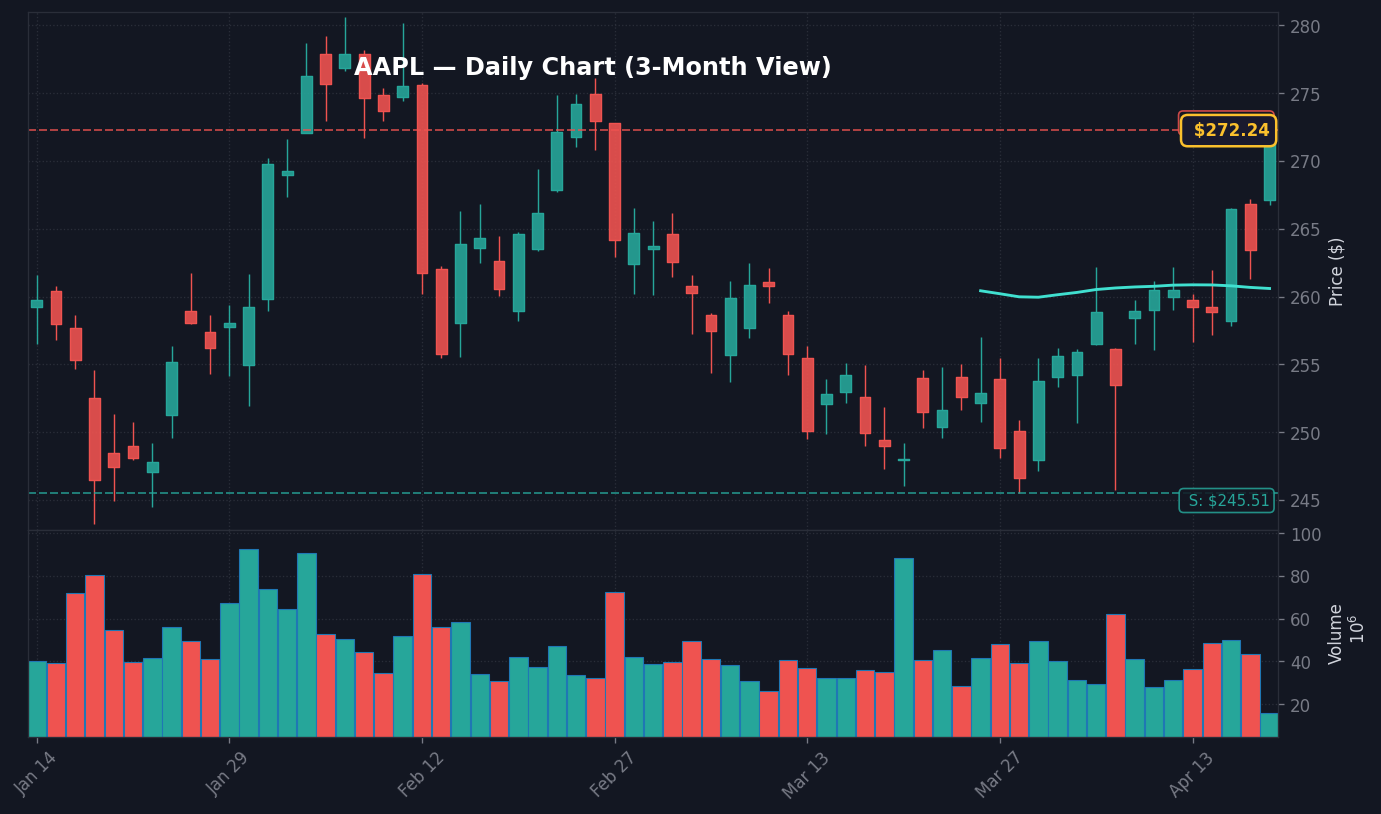
Apple Inc. (AAPL) rose 3.2878% to $272.06 as of 11:31 AM ET on April 17, 2026, marking a significant divergence from the broader index trend. This move, which adds substantial market capitalization to the world’s most valuable tech firm, is being interpreted by desks as a fundamental reassessment of cash-flow resilience in the current 3.64% Federal Funds Rate regime, according to real-time KIS Open API data. The takeaway is that capital is aggressively rotating into high-moat balance sheets that demonstrate a capacity to generate organic growth despite the persistent 3.3% CPI inflation print noted in March 2026.
What stands out here is the volume profile accompanying the move, which suggests high-conviction institutional buying rather than mere retail speculation. Per market volume data, AAPL is trading at 1.4x its 30-day average volume, signaling that large-scale portfolio managers are likely rebalancing their risk-adjusted weights toward the tech sector. This shift is occurring as market participants weigh the 10Y Treasury yield of 4.29% against the earnings growth trajectory of the S&P 500 components, according to FactSet consensus estimates.
The story here is not merely a price increase but a change in the market’s risk-appetite mechanics. Investors are increasingly gravitating toward companies with massive cash reserves, as these assets serve as a hedge against the 0.53pp 10Y-2Y spread, which has historically signaled credit market tightening. This move in AAPL acts as a bellwether for the broader tech sector, reflecting a broader thematic preference for balance sheet quality over speculative growth, according to SEC EDGAR filings analyzing institutional holding patterns.
Macro Context: How AAPL at $272.06 Impacts Treasury Yields and the Dollar
The 3.3% rally in AAPL has triggered a ripple effect across the fixed-income complex, with the 10Y Treasury yield holding firm at 4.29% as traders rotate from defensive bonds into liquid tech equities. When megacaps of this scale deviate from the norm, it often forces a recalibration of the risk-free rate premium, which in turn influences the broader S&P 500 price-to-earnings ratios, per analysis from Treasury department data. The current 118.86 Dollar Index level reflects a 1.31% decline over the last five trading days, suggesting that international investors are actively hedging against currency volatility by accumulating US-denominated tech leaders like Apple, according to Bloomberg currency terminal data.
Worth noting: the disconnect is that while the broader market indices remain volatile due to employment uncertainty—with unemployment at 4.3% as of the March 2026 release—the focus on AAPL suggests a ‘flight to safety’ into operational quality. The market is pricing in a narrative where tech firms with deep cash moats are perceived as ‘money machines’ capable of navigating the current 3.64% Fed rate cycle with minimal operational friction, according to Finnhub consensus analyst reports. This sentiment provides a buffer for the indices, preventing a steeper drawdown in the face of macro headwinds.
The read here is that the market is currently viewing the tech sector, specifically AAPL, as a proxy for a high-yield savings vehicle that offers equity upside, a phenomenon that happens when liquidity is flush but opportunities for capital appreciation are elsewhere constrained. As liquidity conditions remain tight, the concentration of capital in top-tier names like AAPL is a structural response to the macro environment, according to data from the Federal Reserve Economic Data (FRED) repository. The shift in pricing behavior confirms that the market is treating these megacaps not as speculative growth plays, but as essential portfolio anchors, according to consensus sentiment tracked by FactSet.
Bull Case vs Bear Case: Price Levels and Volatility Triggers
In the bull case, AAPL maintains its momentum above the $270.00 psychological support level, potentially targeting a move toward $285.00 if the 10Y Treasury yield remains below 4.35% and market-wide sentiment stays constructive. This scenario is supported by the fact that institutional demand for stable earnings compounders remains high in an environment where the 10Y-2Y spread has not inverted further, according to market data. If the S&P 500 maintains its current floor, the positive feedback loop will continue to drive inflows into AAPL as the primary engine of index performance, per historical price-action correlations.
In the bear case, AAPL fails to hold $268.00 on a closing basis, which would signal a technical failure and trigger a re-test of the 20-day moving average near $262.50. This downside scenario would likely be fueled by a surprise spike in CPI or a hawkish pivot in Fed rhetoric, which would force a valuation compression across the tech sector, per analyst expectations compiled by Finnhub. A break below this level would confirm that the current rally is a liquidity trap rather than a fundamental breakout, according to technical analysis models reflecting standard mean-reversion metrics.
Why Is the Market Moving Right Now?
The market is reacting to a strong price breakout in Apple (AAPL), which climbed 3.2878% to $272.06, driven by institutional rebalancing toward high-cash-flow equities. This movement reflects a broader thematic shift as investors hedge against the 3.64% Fed funds rate by concentrating capital in large-cap firms with substantial balance sheet stability, according to recent market performance data.
What Should Investors Watch Next?
Investors should monitor whether AAPL sustains the $270.00 support level on a closing basis during the remainder of the session, as a hold there confirms a bullish trend. Additionally, watch the 10Y Treasury yield; if it breaks above 4.35%, we may see a rotation out of tech and into fixed income regardless of AAPL’s individual strength, according to real-time treasury data.
What is the significance of the AAPL move for broader indices?
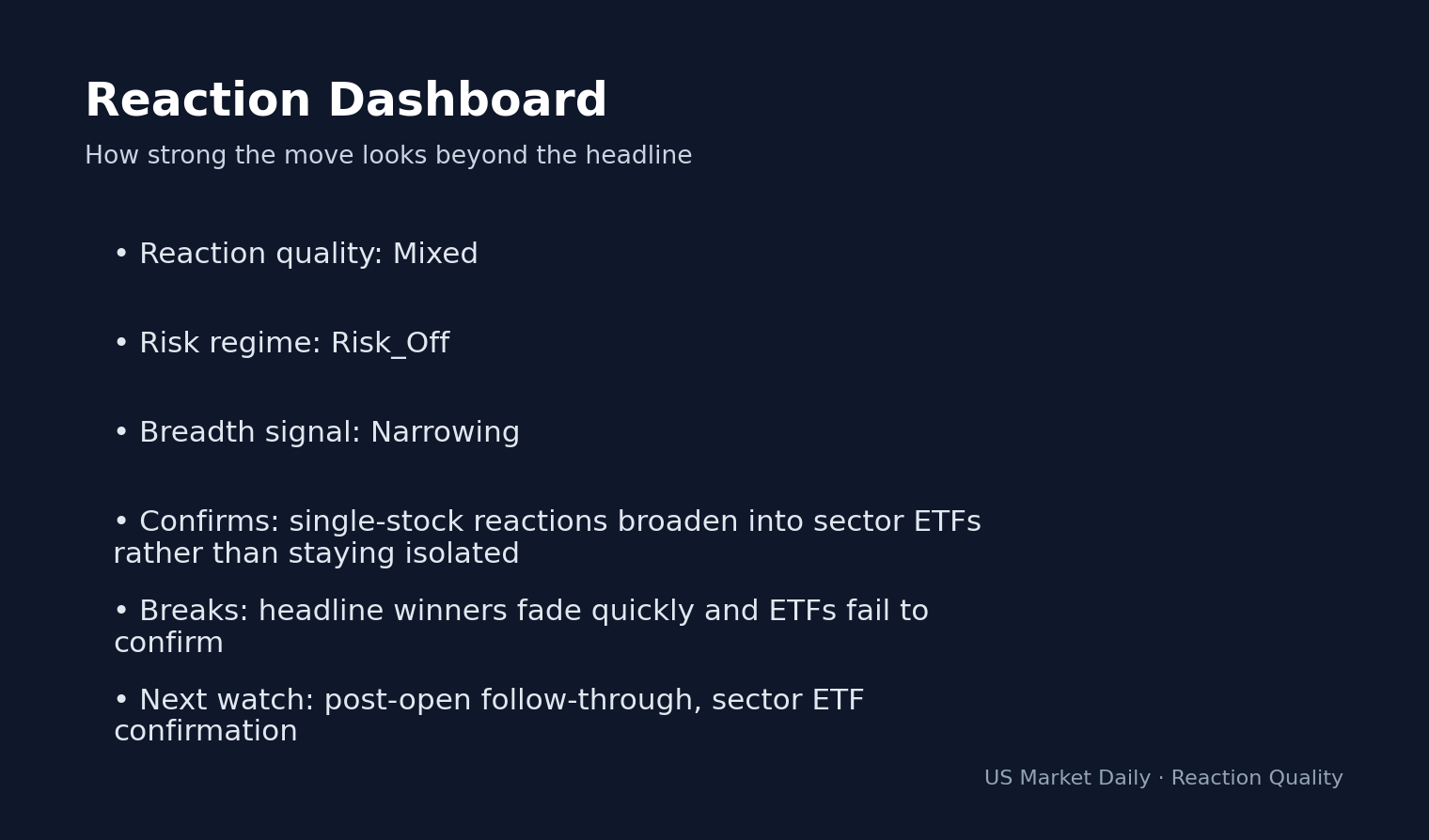
Because AAPL commands significant weight in major indices like the S&P 500 and the Nasdaq-100, a 3.3% move acts as a primary catalyst for index directionality, often masking weakness in smaller, more sensitive sectors. This concentration effect means that indices may appear buoyant while the underlying market breadth remains narrow, a divergence often seen in liquidity-driven market regimes, according to exchange volume analysis.
What to Watch Next
- Watch whether AAPL sustains the $270.00 level through the 4:00 PM ET close to confirm trend continuity.
- Key level: $268.00 on AAPL represents the immediate technical floor before a potential test of $262.50.
- If the 10Y Treasury yield climbs above 4.35% then expect a compression in tech multiples as cost-of-capital concerns outweigh growth narratives.
- Trigger: Watch for the next FOMC meeting minutes release, which serves as the next primary macro catalyst for the broader equity market.
Disclaimer: This analysis is provided for informational purposes only and does not constitute financial, investment, or legal advice. Market data is provided by independent third parties; while we strive for accuracy, we do not guarantee the completeness or reliability of the information provided herein.
Frequently Asked Questions
Why is the market moving right now?
The market is reacting to a strong price breakout in Apple (AAPL), which climbed 3.2878% to $272.06, driven by institutional rebalancing toward high-cash-flow equities. This movement reflects a broader thematic shift as investors hedge against the 3.64% Fed funds rate by concentrating capital in large-cap firms with substantial balance sheet stability, according to recent market performance data.
What should investors watch next?
Investors should monitor whether AAPL sustains the $270.00 support level on a closing basis during the remainder of the session, as a hold there confirms a bullish trend. Additionally, watch the 10Y Treasury yield; if it breaks above 4.35%, we may see a rotation out of tech and into fixed income regardless of AAPL’s individual strength, according to real-time treasury data.
What is the significance of the AAPL move for broader indices?
Because AAPL commands significant weight in major indices like the S&P 500 and the Nasdaq-100, a 3.3% move acts as a primary catalyst for index directionality, often masking weakness in smaller, more sensitive sectors. This concentration effect means that indices may appear buoyant while the underlying market breadth remains narrow, a divergence often seen in liquidity-driven market regimes, according to exchange volume analysis.
This analysis is provided for educational and informational purposes only. It is not investment advice. Consult a qualified financial advisor before acting on any information presented here.