Market SnapshotAs of 2026-07-23 06:09 ET (intraday change)
S&P 500
$747.41
▼ -0.12%
Nasdaq 100
$705.35
▼ -0.51%
Russell 2000
$293.79
▼ -0.93%
VIX
16.64
▼ -2.40%
US 20Y
$83.44
▼ -0.26%
Dollar
101.12
▼ -0.06%
Gold
$379.12
▲ +1.15%
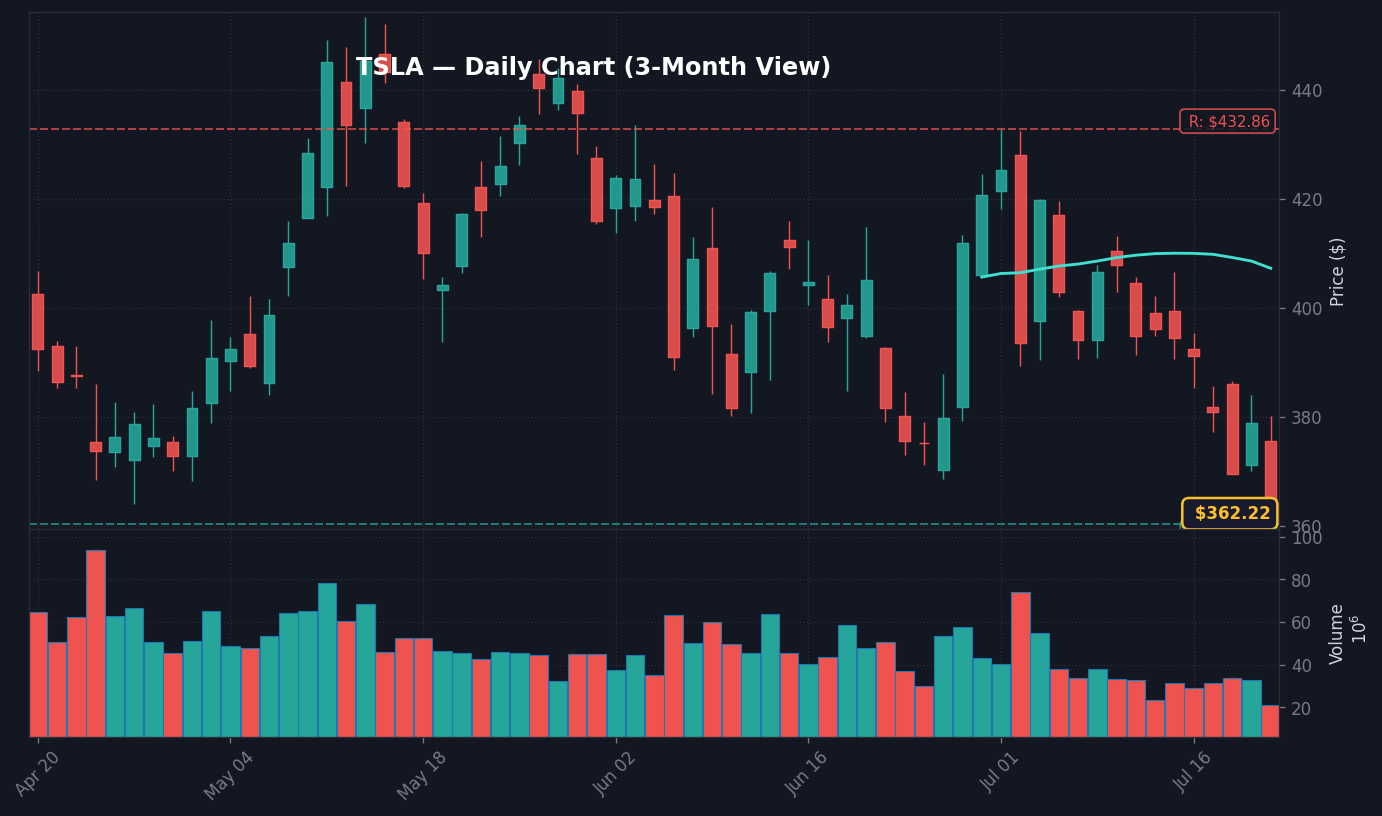
What changed at 05:05 PM ET on July 22, 2026? TSLA’s SEC 8-K hit a rate-sensitive tape, not a confirmed index break: the 10Y Treasury stood at 4.63%, up 8bp over 5 days, VIX was 17.1 versus a 20-day average of 16.9, and the broad Dollar Index was 120.53, down 0.17% over 5 days, per supplied FRED data.
The catalyst is the TSLA SEC 8-K Filing (2026-07-22), filed on July 22, 2026 and flagged as high severity in the supplied event feed, with the filing page available through the SEC archive. No TSLA after-hours price move, volume ratio, index print, or sector performance table was supplied, so the correct first read is confirmation discipline rather than price-story certainty.
The risk is simple: a 5:05 PM ET filing headline can move a thin post-close tape before regular-session liquidity shows whether the message is TSLA-specific or index-relevant. Sticky CPI at 3.7% and a fed funds rate of 3.63% as of June 1 constrain the upside case because rate-cut relief is not the immediate default setting, per supplied FRED data.
The confirmed change is that TSLA filed an 8-K dated July 22, 2026, per the SEC archive. The unconfirmed part is the market magnitude: the prompt did not provide a TSLA last sale, after-hours percentage move, bid-ask spread, options-implied move, S&P 500 level, Nasdaq level, or sector breakdown.
That missing price tape matters. In a normal breaking alert, the first number would be TSLA up or down by a defined percentage. Here, the market signal has to come from the surrounding macro frame: the 10Y at 4.63%, the 2Y at 4.26%, and the 10Y-2Y spread at 0.37pp, per supplied FRED data. That curve shape says equities are not getting help from an obvious recession hedge or an aggressive duration bid.
What stands out here is that the 8-K is arriving into a market that is already paying attention to inflation persistence. CPI was 3.7% year over year as of June 1, while the policy rate was 3.63%, per supplied FRED data. That mix limits the market’s ability to treat every single-name shock as a dip-buying event backed by imminent Fed easing.
The tape is telling us to separate the headline from the confirmation. The SEC filing is real. The immediate TSLA price reaction is not provided. The index spillover is not provided. The sector read-through is not provided. That turns this into a watchlist-driven alert, not a full verdict.
Why Does the TSLA 8-K Matter With the 10Y at 4.63%?
The TSLA 8-K matters because mega-cap growth risk is most sensitive when the discount-rate backdrop is already tight. The 10Y Treasury at 4.63%, after an 8bp 5-day increase, raises the hurdle for long-duration equity stories, per supplied FRED data.
That does not mean the filing is automatically negative. The supplied data does not include the 8-K item description, filing text, management commentary, or a company call time. It does mean the market’s tolerance for ambiguity is lower than it would be with falling yields, a falling VIX, and a clear dollar tailwind.
The cross-asset bridge is the key: a 0.37pp 10Y-2Y spread, a VIX reading of 17.1, and a broad Dollar Index at 120.53 create a tape where TSLA-specific uncertainty can bleed into index risk if liquidity confirms selling pressure at the July 23 open, per supplied FRED data. Rates set the valuation frame. Volatility sets the urgency. The dollar shows whether the stress is local or macro.
The overlooked read-through is that TSLA does not need a clearly negative filing item to matter for the broader tape. If traders are already positioned for sticky inflation and delayed cuts, even ambiguous company news can trigger a de-risking pass because the cost of waiting for clarity is higher when yields are elevated. That is the part a simple headline scan misses.
Worth noting: the supplied market data block did not include current S&P 500, Nasdaq, Dow, or sector performance figures. Without those numbers, any claim that the TSLA filing has already hit the full market would be unsupported. The honest interpretation is narrower: TSLA is the catalyst, rates are the constraint, and July 23 regular liquidity is the test.
What Is Confirmed in the Jul 22 SEC Record?
The confirmed facts are limited but important. TSLA filed a Form 8-K on July 22, 2026, the filing was tagged high severity in the supplied breaking-events feed, and the source URL points to the SEC archive for Tesla, Inc. filings, per the supplied SEC event data.
Beyond that, the prompt does not provide the filing item number, exhibit text, named executive, transaction size, guidance language, legal exposure, accounting figure, or balance-sheet impact. That absence should keep the analysis disciplined. A Form 8-K can cover several types of material events, but no specific event category was supplied here.
The judgment: the filing status itself is enough for a breaking alert because TSLA is a market-sensitive single name. It is not enough to assign a fundamental earnings impact, valuation impact, or price target. Any precise claim about revenue, margins, deliveries, debt, governance, or litigation would require filing text that is not present in the supplied data.
The macro context is more complete than the company context. Fed funds at 3.63%, CPI at 3.7%, unemployment at 4.2%, the 10Y at 4.63%, the 2Y at 4.26%, and VIX at 17.1 are all supplied in the FRED snapshot. Those numbers make the market regime legible even while the company-specific details remain incomplete.
The disconnect is that traders often want a one-line reason before the market has produced one. At 05:05 PM ET, the one-line reason is not yet the content of the filing. It is the combination of a high-severity TSLA SEC event and a sticky-inflation macro setup that makes the next session’s confirmation more important than the first reaction.
What Is Not Confirmed Before the Jul 23 Open?
The missing pieces are the TSLA after-hours percentage move, the after-hours price level, the trading volume ratio, options pricing, market-maker positioning, and any company response. The supplied market data also does not include S&P 500 support or resistance from today’s technical snapshot, so no exact index level can be cited without inventing data.
That is the most important constraint for traders reading this at 05:05 PM ET. The headline is official because it comes from the SEC archive, but the market interpretation is still tentative because liquidity has not been proven in the regular session. A post-close move can be exaggerated by thin books, stale quotes, and option hedging before the next cash open.
Counterintuitively, the absence of a supplied TSLA price move makes the macro numbers more useful, not less. The 10Y at 4.63% and VIX at 17.1 give investors a framework for judging whether the filing becomes an index event. If yields hold firm and VIX pushes away from its 20-day average of 16.9, the market may treat TSLA news as part of a broader duration-risk problem, per supplied FRED data.
The dollar is the quieter tell. The broad Dollar Index was 120.53, down 0.17% over 5 days, per supplied FRED data. A falling dollar would normally help global risk appetite at the margin, but that benefit is not decisive when the 10Y has moved higher over the same 5-day window. The bond market is the heavier input here.
Where consensus is wrong: the first debate should not be whether the 8-K is bullish or bearish in isolation. The better question is whether the market has room to absorb uncertainty when CPI is still 3.7% and the Fed funds rate is 3.63%. In a softer inflation regime, TSLA ambiguity might be treated as a company-only event. In this regime, the same ambiguity can pressure growth multiples if rates refuse to relax.
3 Scenarios for TSLA After the Jul 22 8-K
3 Scenarios From Here
Bull: VIX moves back below its 20-day average of 16.9 while the 10Y holds at or below 4.63% into the July 23 US open → TSLA’s 8-K is treated as a single-name event; no exact TSLA upside target can be stated because no TSLA price level was supplied.
Base: VIX stays near 17.1 and the 10Y stays near 4.63% through the first regular-session liquidity window on July 23 → TSLA trades as a confirmation story while investors wait for filing details, company response, or volume-backed price discovery.
Bear: The 10Y extends above the supplied 4.63% level after its 8bp 5-day rise and VIX holds above 17.1 → the filing becomes a broader growth-stock stress signal; no exact TSLA downside level can be stated because no reference price was supplied.
The asymmetry is not clean enough for a price target because the TSLA quote data is absent. The asymmetry is macro-based: a lower-volatility, stable-yield tape can quarantine the filing, while a higher-yield, higher-vol tape can turn a single-name catalyst into an index-risk problem.
The base case deserves the most weight until the July 23 open supplies tradable confirmation. The SEC record is confirmed, but the market reaction is not yet fully measurable from the prompt. That makes volume, breadth, and index support more important than the first post-close print.
The bear case becomes more credible if TSLA weakness appears at the same time as rising yields. That combination would imply investors are marking down duration-sensitive equity risk rather than simply reacting to a Tesla filing. The bull case needs the opposite: rates stable, volatility contained, and no spread into the S&P 500.
What Should Traders Watch Before the Jul 23 Open?
The first test is whether TSLA’s filing reaction spreads into index futures and sector breadth when regular liquidity returns on July 23. The supplied data did not include index futures, sector performance, or today’s S&P 500 technical snapshot, so the exact support/resistance level is unavailable.
The second test is cross-asset confirmation. If VIX stays above 17.1 while the 10Y holds near 4.63% or rises further, the market is treating the filing as part of a broader risk repricing rather than a company-only headline, based on the supplied FRED data.
What to Watch: Jul 23 S&P 500 Confirmation After TSLA 8-K
Watch whether TSLA’s post-close reaction broadens into S&P 500 pressure when regular liquidity returns on July 23; no index percentage move was supplied in the prompt.
Key level: No exact S&P 500 support/resistance number was supplied in today’s technical snapshot, so the nearest level cannot be stated without inventing data.
If the 10Y Treasury stays near 4.63% and VIX stays near 17.1 then the TSLA 8-K is more likely to remain a single-name event than a full index stress signal.
Trigger: TSLA SEC 8-K filing dated July 22, 2026, with the next regular-session confirmation at the July 23, 2026 US open; no separate company call time was supplied.
Next Session Watchpoints
Volume profile: Watch whether TSLA keeps at least follow-through volume versus normal.
Key level to watch: Use the nearest recent S&P 500 support/resistance level from today’s technical snapshot. is the pivot for continuation.
Catalyst quality: The move needs follow-through headlines or clean price acceptance above the pivot.
Risk trigger: If TSLA loses the opening range quickly, the move shifts from continuation to fade risk.
Frequently Asked Questions
What happened with the TSLA SEC 8-K filing on July 22, 2026?
TSLA filed a Form 8-K dated July 22, 2026, per the supplied SEC archive event. The prompt did not include the filing item text or a TSLA after-hours price move, so the market impact cannot be stated as a percentage.
Why does the 10Y Treasury at 4.63% matter for TSLA?
The 10Y Treasury was 4.63%, up 8bp over 5 days, per supplied FRED data. That matters because higher discount rates make long-duration growth stocks more sensitive to company-specific uncertainty.
What confirms whether the TSLA 8-K affects the broader market?
The confirmation comes from July 23 regular-session liquidity, S&P 500 breadth, and cross-asset follow-through. If VIX stays near or above 17.1 while the 10Y holds near 4.63%, the filing is more likely to be treated as a broader risk signal.
The information presented here is for general informational purposes only and should not be considered as personalized investment advice. All investing involves risk.