Market SnapshotAs of 2026-07-20 00:15 ET (intraday change)
S&P 500
$743.29
▼ -0.99%
Nasdaq 100
$695.33
▼ -1.50%
Russell 2000
$294.04
▼ -0.52%
VIX
18.77
▲ +12.19%
US 20Y
$84.52
▲ +0.37%
Dollar
100.75
◆ +0.02%
Gold
$368.41
▲ +0.95%
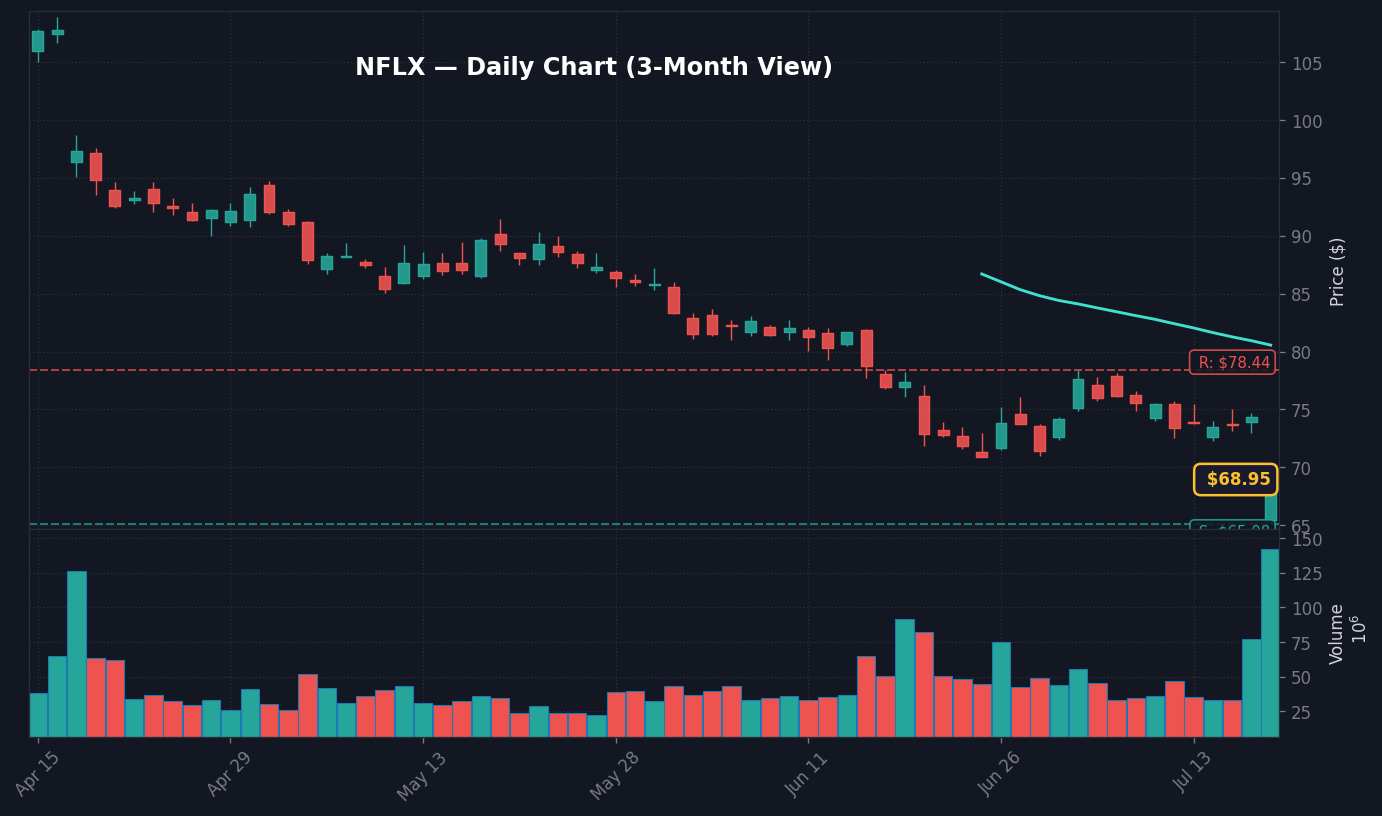
Does a 7.3% NFLX drop to $68.95 at 11:12 AM ET on July 19 expose the market’s biggest hidden risk? Yes: the live alert is not just that Netflix is lower, but that a growth-slowdown headline can turn a perceived mega-cap compounder into a valuation problem in one session, per the supplied breaking-events feed.
The driver is specific: NFLX is down 7.2629% after a Netflix growth-slowdown alert framed as a shareholder trap and Chart of the Day, per the supplied breaking-events feed. The macro backdrop makes that drop harder to dismiss because CPI is 3.7%, fed funds are 3.63%, and the 10Y Treasury is 4.57%, which means lower-rate relief is not the clean rescue path for long-duration equity multiples, per FRED data.
The key risk is mistaking the first NFLX print for the full market message before liquidity and confirmation arrive. The supplied index and sector-performance fields are blank, so this note cannot honestly call the move a confirmed S&P 500 or Nasdaq selloff; what stands out is the asymmetry of the information, because the single-stock signal is sharp while the market-wide confirmation data is missing.
How Does a 4.57% 10Y Change the NFLX Read-Through?
NFLX Daily Chart — 3-Month View with SMA50/200
The 10Y Treasury at 4.57%, the 2Y at 4.16%, and the 10Y-2Y spread at 0.41 percentage point matter because they keep the discount-rate pressure on long-duration equities, per FRED data. When inflation is sticky at 3.7%, a growth scare does not get the same valuation cushion it might receive in a fast-cutting Fed regime.
This is the cross-asset bridge that matters most. The VIX is 16.7 versus a 20-day average of 16.9, while the broad Dollar Index is 120.50 and down 0.27% over five days, per FRED data. That mix says the NFLX move is not yet a classic volatility shock or dollar-driven risk-off event. It is more surgical: the equity market is attacking a specific growth narrative while macro volatility remains contained.
The overlooked signal: the 10Y-2Y curve at +0.41 percentage point is not giving investors the deep inversion playbook where weak growth quickly pulls forward aggressive rate cuts, per FRED data. That is the problem for NFLX-style duration. If a company-specific growth slowdown arrives while the curve is positive and CPI is still 3.7%, the equity multiple has to absorb more of the adjustment itself.
Counterintuitively, a VIX at 16.7 can make the NFLX alert more important, not less. If the move happened with VIX at a panic level, it could be dismissed as part of broad de-risking. With VIX slightly below its 20-day average of 16.9, per FRED data, the tape is saying this is not yet a volatility liquidation. It is a targeted repricing of a named stock after a named catalyst.
The Fed backdrop also constrains the bull case. Fed funds at 3.63% and CPI at 3.7% leave little room for an easy argument that policy relief will quickly offset slower growth, per FRED data. That does not mean NFLX has to keep falling. It does mean the rebound case needs company-specific confirmation, not just a macro multiple bounce.
What Is Known at 11:12 AM ET: NFLX $68.95, No Index Tape
At 11:12 AM ET on July 19, the known data are narrow but forceful: NFLX is down 7.2629% to $68.95, the severity flag is HIGH, and the headline cites Netflix’s growth slowdown, per the supplied breaking-events feed. No S&P 500 level, Nasdaq level, Dow level, sector-performance table, or market-breadth reading was supplied.
That missing market tape changes the discipline of the alert. The right conclusion is not that the entire market has already confirmed a growth-stock unwind. The right conclusion is that a mega-cap move has created a live test for the next US session: whether index futures, megacap peers, volatility, and rates begin to echo the single-stock stress or leave it isolated inside NFLX.
What stands out here is the difference between speed and confirmation. The speed is visible in the 7.2629% drop. Confirmation is not visible because the supplied market-index and sector blocks are empty. A trader can act on speed, but an analyst should not overstate confirmation. That is especially true in a sticky-inflation regime, where a single weak growth print can look macro-relevant before the broader tape actually says it is.
The current macro inputs do not create a clean all-clear. The 10Y Treasury is 4.57%, up 1 basis point over five days, while the 2Y Treasury is 4.16%, per FRED data. That is not a dramatic rate shock, but it is high enough to keep valuation math tight. The broad Dollar Index at 120.50, down 0.27% over five days, also does not point to a dollar squeeze as the main catalyst, per FRED data.
The practical consequence is that NFLX has to solve its own problem first. If the move is only about one company, the share price needs to stabilize near $68.95 and then work back toward the implied pre-drop reference near $74.35. If the move becomes a market message, the missing confirmation should appear in index weakness, sector deterioration, or a VIX move above the 16.9 20-day average. Those readings were not supplied, so they remain watchpoints rather than claims.
What Is Not Known in the NFLX 7.3% Growth Headline?
The missing data are material: the prompt does not provide Netflix subscriber additions, revenue growth, EPS, free cash flow, operating margin, guidance, analyst revisions, management commentary, option-implied move, trading volume, or short interest. Without those figures, no precise claim can be made about whether the 7.2629% drop is earnings-driven, guidance-driven, valuation-driven, or positioning-driven beyond the supplied growth-slowdown headline.
This is where consensus often gets lazy. The phrase growth slowdown sounds complete, but it is not a model. It does not specify whether the pressure is coming from subscriber saturation, advertising monetization, pricing resistance, churn, content spend, currency, or competitive intensity. The supplied alert gives the direction of the catalyst and the market’s first judgment. It does not give the operating bridge.
The disconnect is that traders can see the price break immediately while fundamental investors still need the denominator. If the growth slowdown is shallow and temporary, $68.95 may prove to be an overreaction against an implied prior level near $74.35. If the slowdown changes the long-term growth rate, the first 7.2629% leg may be only the market’s initial reset. Both interpretations are plausible from the supplied data, and neither can be proven without the missing company figures.
The official-event flag is also false in the supplied regime context, which means this is not a Fed, BLS, EIA, or SEC release-time shock. That matters because official macro releases arrive with standardized timestamps and primary documents. This NFLX alert arrives as a company-specific market event with incomplete operating detail. The market can price it instantly, but the analytical burden is higher.
Bull, Base, Bear for NFLX at $68.95
Bull case: NFLX stabilizes above $68.95 during the July 19 US cash session and moves back toward the implied pre-drop reference near $74.35, based on the supplied $68.95 price and 7.2629% decline. That would be roughly a full retracement of the breaking move, not a new fundamental target. The bull interpretation is that the growth-slowdown headline created a fast valuation reset, but not a durable break in the franchise narrative.
Base case: NFLX holds near $68.95 while the broader market withholds confirmation. In that path, the stock remains below the implied pre-drop reference near $74.35, and the move stays defined as an unresolved single-name shock rather than a confirmed macro rotation. The base case is not comfortable for shareholders because sticky CPI at 3.7% and a 10Y Treasury at 4.57% keep the burden of proof on company-specific growth repair, per FRED data.
Bear case: NFLX fails to hold $68.95 and extends by another 7.2629% leg to roughly $63.94, using the same percentage decline supplied in the live alert as a mechanical downside reference. That would signal the market is no longer debating whether the move was too harsh; it would be repricing the growth slowdown as a larger multiple reset. The bear case gains force if VIX rises above its 20-day average of 16.9 or if index and sector data begin confirming broader risk reduction, but those confirmation figures were not supplied.
The asymmetry is clean. Upside to the implied pre-drop reference near $74.35 is about $5.40 from $68.95, while a second equal-percentage downside leg points to roughly $63.94. That creates a narrow tactical map with a wide interpretive gap: the chart can mark levels, but the missing company growth data determines whether those levels are support, resistance, or just the first stop in a larger repricing.
What the Tape Isn’t Pricing Yet: A 16.7 VIX Is Too Calm for a Full Growth Scare
The VIX at 16.7 versus a 20-day average of 16.9 suggests the options market, at least in the supplied macro snapshot, is not treating the NFLX drop as a broad volatility event, per FRED data. That is the non-consensus part of the alert: the risk may be less about immediate index panic and more about a slow rotation out of stocks whose valuation depends on clean growth persistence.
If that reading is right, the next trade is not necessarily a one-day collapse in the S&P 500. It is a discrimination trade. Stocks with visible earnings, nearer-term cash flow, or lower dependence on terminal-growth assumptions should screen better than names where the market has to capitalize distant growth at a 4.57% 10Y Treasury rate. The supplied data does not include sector returns, so that rotation cannot be quantified here, but the logic follows directly from the rate backdrop and the NFLX catalyst.
That is why the missing S&P 500 technical snapshot matters. The article brief requires the nearest recent S&P 500 support or resistance level, but no such level was supplied in the prompt. The honest watchpoint is therefore conditional: if the S&P 500 tests a provided support level later in the session, NFLX becomes part of a market confirmation story; without that index level, $68.95 remains the only exact tradable anchor in the supplied data.
The tape is telling us to separate price damage from market damage. Price damage is already visible in NFLX at -7.2629%. Market damage needs breadth, index levels, sector performance, and volatility confirmation. Until those arrive, the alert is severe, but not yet broad.
What to Watch: NFLX $68.95 and S&P Confirmation
Watch whether NFLX can hold $68.95 after the 11:12 AM ET print while S&P 500 support/resistance data remains unavailable in the supplied technical snapshot.
Key level: $68.95, the live NFLX price attached to the -7.2629% breaking move per the supplied breaking-events feed; the requested nearest S&P 500 support/resistance level was not provided.
If NFLX reclaims the implied pre-drop level near $74.35 then the July 19 move reads more like a valuation reset than a confirmed mega-cap de-risking signal.
Trigger: No dated Netflix company catalyst was supplied; the next hard confirmation point in this note is US cash-session trading after 11:12 AM ET on July 19, 2026.
Next Session Watchpoints
Volume profile: Watch whether NFLX keeps at least follow-through volume versus normal.
Key level to watch: Use the nearest recent S&P 500 support/resistance level from today’s technical snapshot. is the pivot for continuation.
Catalyst quality: The move needs follow-through headlines or clean price acceptance above the pivot.
Risk trigger: If NFLX loses the opening range quickly, the move shifts from continuation to fade risk.
Frequently Asked Questions
Why is NFLX stock down 7.3% on July 19?
NFLX is down 7.2629% to $68.95 after a live alert tied the move to Netflix’s growth slowdown and a shareholder-trap narrative, per the supplied breaking-events feed. The prompt does not provide subscriber, revenue, EPS, or guidance figures, so the precise operating driver is not available.
Can Netflix stock recover the implied $74.35 pre-drop level?
The implied pre-drop reference is near $74.35, calculated from the supplied $68.95 price and 7.2629% decline. A recovery toward that level would suggest the July 19 move was a fast valuation reset, while failure to hold $68.95 would keep pressure on the bear case.
How do Treasury yields affect the NFLX selloff?
The 10Y Treasury is 4.57%, the 2Y Treasury is 4.16%, and CPI is 3.7%, per FRED data. That sticky-rate backdrop limits the case for a quick multiple rebound because slower-growth equities get less help from falling discount rates.
Nothing in this article should be construed as a recommendation to buy or sell any security. Past performance does not guarantee future results.