Market SnapshotAs of 2026-07-23 05:55 ET (intraday change)
S&P 500
$747.41
▼ -0.12%
Nasdaq 100
$705.35
▼ -0.51%
Russell 2000
$293.79
▼ -0.93%
VIX
16.64
▼ -2.40%
US 20Y
$83.44
▼ -0.26%
Dollar
101.11
▼ -0.07%
Gold
$379.12
▲ +1.15%
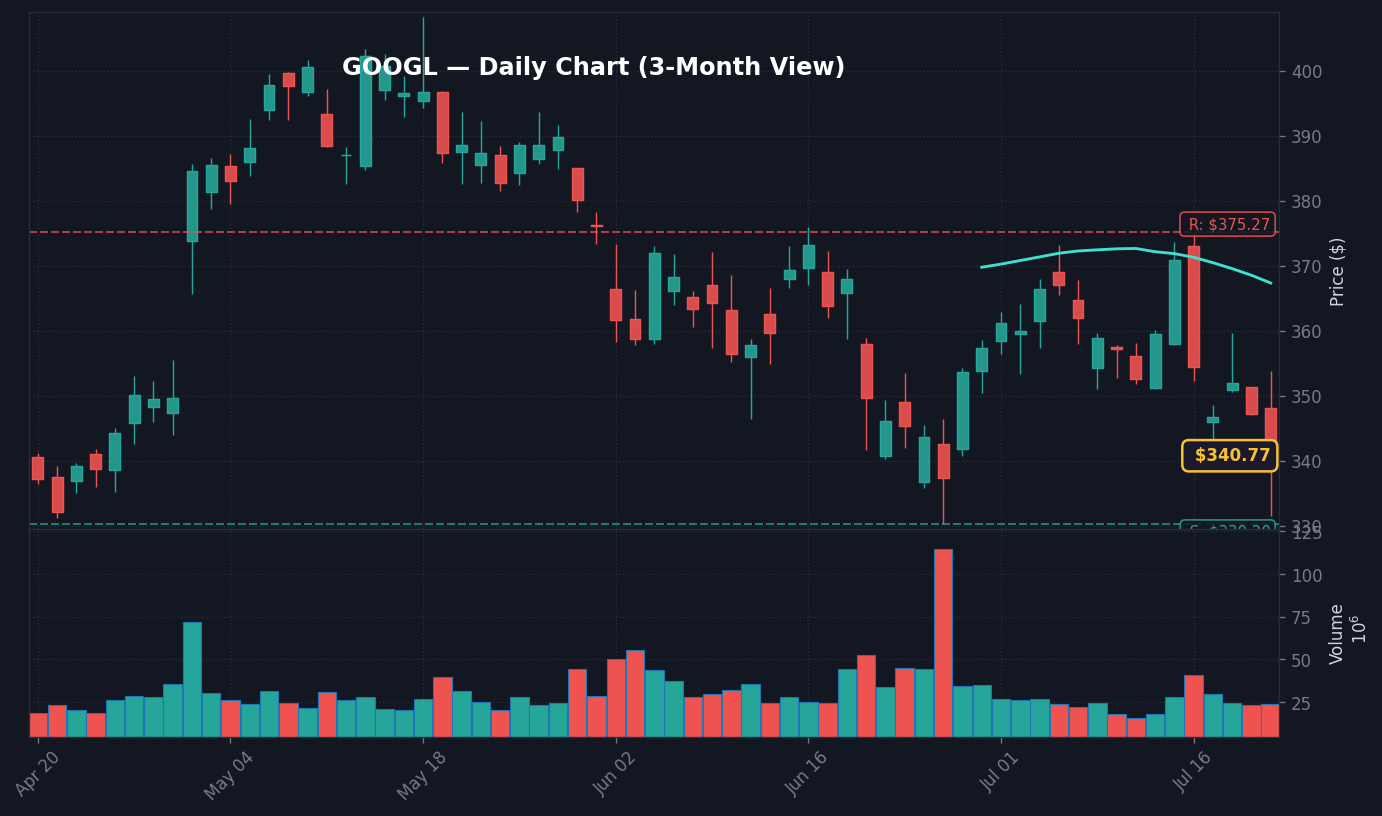
At 04:50 PM ET on July 22, 2026, GOOGL became the high-severity market alert after Alphabet filed an SEC 8-K dated July 22, 2026, per the SEC archive notice.
The thesis is narrow but urgent: the story is the GOOGL SEC 8-K Filing (2026-07-22) itself, not a completed stock-price verdict, because the alert feed did not include a GOOGL after-hours price, percentage move, bid-ask spread, or volume ratio. That makes this a confirmation trade first and a valuation debate second.
The risk is treating the first reaction as the full-market message before liquidity, filing details, and index spillover are visible. Sticky inflation also constrains the upside read-through: fed funds stood at 3.63% as of June 1, 2026, and CPI was 3.7% year over year as of June 1, 2026, per FRED data, so the rates backdrop is not giving megacap growth a free multiple expansion.
GOOGL was flagged as a high-severity alert at 04:50 PM ET after Alphabet filed an SEC 8-K dated July 22, 2026, per the SEC archive notice. The exact stock move was not supplied, which means the confirmed catalyst is the filing event, not a measured price reaction.
What stands out here is the sequencing. A high-severity SEC filing alert in GOOGL can hit traders before the market has a clean read on whether the filing is routine, financial, legal, governance-related, or transaction-related. That gap between event detection and content interpretation is where bad trades happen, because the first screen flash can look more informative than it is.
The alert also lands with no current market index data attached. The market indices and sector performance fields in the available snapshot were blank, so there is no supplied S&P 500, Nasdaq, Dow, XLK, or communication-services move to tie directly to GOOGL at publication. That absence matters. Without a confirmed index reaction, the better read is that the market has a company-specific filing to parse, while broader risk appetite still needs proof.
For active traders, the clean distinction is this: an SEC 8-K is a hard catalyst, but the supplied data does not show a hard price magnitude. The GOOGL SEC 8-K Filing (2026-07-22) can still become market-moving once the item detail is read, but the current evidence does not justify assigning a specific upside or downside percentage.
Why Does GOOGL 8-K Risk Matter With the 10Y at 4.63%?
The 10Y Treasury was 4.63% as of July 21, 2026, up 8 basis points over five days, while the 2Y Treasury was 4.26%, leaving the 10Y-2Y spread at 0.37 percentage points, per FRED data. That curve setup matters for GOOGL because long-duration equity cash flows are more sensitive to discount-rate pressure when filing uncertainty arrives.
The cross-asset bridge is straightforward: if the 10Y is already at 4.63% and rising over five days, an ambiguous megacap filing has less room to be shrugged off as noise. Higher long-end yields do not have to create a selloff by themselves, but they reduce the market’s tolerance for uncertainty in stocks where terminal cash-flow expectations carry a large part of valuation.
VIX was 17.1 versus a 20-day average of 16.9, per FRED data, which signals volatility was not yet in panic mode but was also not deeply complacent. The Dollar Index stood at 120.53, down 0.17% over five days, per FRED data, so the currency tape was not the main stress signal. The rate signal is cleaner than the dollar signal.
Signal
Latest supplied reading
Read-through for GOOGL
Fed funds
3.63% as of June 1, 2026, per FRED data
A higher policy-rate floor limits the upside thesis unless the 8-K detail is clearly benign.
10Y Treasury
4.63%, with a 5-day change of +8bp as of July 21, 2026, per FRED data
Rising long-end yields raise the bar for megacap growth multiple expansion.
2Y Treasury
4.26%, per FRED data
Front-end rates still reflect a policy backdrop that is not aggressively easing.
10Y-2Y spread
0.37 percentage points, per FRED data
A positive curve gives banks and cyclicals a different message than growth stocks receive from the 10Y.
VIX
17.1 versus a 20-day average of 16.9, per FRED data
Volatility is slightly above its recent average, so a filing shock can travel faster if details disappoint.
CPI
3.7% year over year as of June 1, 2026, per FRED data
The labor backdrop does not by itself force an immediate risk-off read.
Broad Dollar Index
120.53, down 0.17% over five days, per FRED data
The dollar is not the primary stress channel in this alert.
The overlooked signal is that volatility is only slightly above its 20-day average while rates have moved higher over five days. That combination says the equity market may not have fully prepaid for a negative filing interpretation. If the 8-K detail is benign, that matters less. If the detail is adverse, the rates backdrop can make the second move sharper than the first.
What Is Known From the July 22 SEC 8-K Notice?
The known facts are limited and specific: the ticker is GOOGL, the form is 8-K, the filing date is July 22, 2026, and the SEC archive URL is available, per the SEC archive notice. The alert severity is high, per the breaking-event feed, but severity is not the same as financial impact.
The missing facts are just as important. The alert did not provide the 8-K item number, exhibit list, management commentary, financial restatement language, legal matter, transaction terms, officer-change detail, or guidance update. Without those details, this alert should not be framed as an earnings reset, acquisition headline, regulatory shock, or accounting event.
This is where discipline beats speed. Traders often overfit the form type, but an 8-K can cover a wide range of events. The same form wrapper can contain routine corporate housekeeping or information with immediate valuation consequences. The SEC filing is the starting point; the item detail is the thing that determines whether GOOGL deserves a stock-specific move or a broader communication-services read-through.
What the tape is telling us is narrow: process risk rose before price discovery was fully available. That is not bullish or bearish by itself. It is a warning that the next tradable information will come from confirmation, not from guessing the headline category.
What Is Not Confirmed Before Jul 23 Cash Trading?
No GOOGL after-hours price change, closing price, market capitalization change, options skew, or volume ratio was supplied in the alert. No S&P 500 level, Nasdaq level, Dow level, sector table, or communication-services ETF move was supplied either. The nearest recent S&P 500 support or resistance level requested from the technical snapshot is missing, so this note cannot responsibly invent one.
That missing S&P 500 level is not a minor gap. The must-watch level for a broad-market spillover should be the nearest recent S&P 500 support or resistance area, but the available data set did not include it. The nearest hard levels in the supplied data are cross-asset levels: the 10Y Treasury at 4.63%, the 2Y Treasury at 4.26%, the 10Y-2Y spread at 0.37 percentage points, VIX at 17.1, and the broad Dollar Index at 120.53, per FRED data.
Where consensus is wrong is treating missing reaction data as neutral. In a megacap 8-K alert, no supplied price print at 04:50 PM ET does not prove the filing is routine. It means the informational edge has shifted from speed to verification. The first trader to understand the actual item detail has a better setup than the first trader to react to the form label.
The key risk into July 23, 2026, is a false read-through. If GOOGL gaps on thin liquidity and then reverses when the filing details are digested, the headline move will have been a liquidity event. If GOOGL moves with higher volume and simultaneous pressure in the major indices once cash trading opens, the filing may become part of a broader risk repricing. The current supplied data does not yet separate those two paths.
3 Scenarios for GOOGL After the July 22 8-K
Bull case: the July 22 SEC 8-K detail proves contained, and cross-asset conditions do not worsen into the July 23, 2026 US cash session. The clean macro threshold is the 10Y Treasury staying at or below 4.63% and VIX staying near 17.1, per FRED data. A GOOGL upside target cannot be quantified from the supplied alert because no last sale, closing price, or after-hours percentage move was provided.
Base case: the filing needs interpretation, but there is no immediate evidence of broad market stress. In that case, GOOGL trades as an information gap rather than a macro shock, with the rate backdrop capped by fed funds at 3.63% and CPI at 3.7% year over year, per FRED data. The base case is a confirmation range, not a price range, because the alert did not include a GOOGL reference price.
Bear case: the 8-K detail carries financial, legal, governance, or transaction implications, while the 10Y pushes above the supplied 4.63% level and VIX moves above the supplied 17.1 reading. That would create a two-channel problem: company-specific uncertainty plus higher discount-rate pressure. A specific downside level is unavailable because neither a GOOGL price nor the nearest S&P 500 support level was supplied.
The asymmetry is not in the numbers yet; it is in the confirmation path. A benign filing can remove uncertainty quickly, while a negative filing can force investors to reprice GOOGL while rates are already leaning against long-duration equities. Counterintuitively, the lack of an initial magnitude makes the next confirmed print more important, not less.
What Should GOOGL Traders Watch Before Jul 23 Trading?
Traders should watch the actual 8-K item detail, the first confirmed GOOGL price and volume reaction, and whether cross-asset stress rises from the supplied baseline of 10Y at 4.63% and VIX at 17.1, per FRED data. The nearest S&P 500 support or resistance level was not supplied, so it should not be fabricated.
The tape needs confirmation from liquidity. If the July 23, 2026 cash session shows a GOOGL move without a simultaneous rise in VIX or yields, the read-through may stay stock-specific. If the move comes with a higher 10Y and higher VIX, the filing becomes a broader duration-risk event.
What to Watch: GOOGL 8-K Versus the 4.63% 10Y
Watch whether the July 22 SEC 8-K details are confirmed as routine, financial, governance, legal, or transaction-related; the filing category was not supplied in the alert.
Key level: S&P 500 support/resistance was not supplied; nearest hard cross-asset level is the 10Y Treasury at 4.63% as of July 21, 2026, per FRED data.
If GOOGL price and volume confirmation arrive with VIX still near 17.1 then the reaction can be judged as more stock-specific than broad de-risking.
Trigger: the next hard catalyst is the SEC 8-K filing detail dated July 22, 2026, with follow-through into the July 23, 2026 US cash session; no later company call time was supplied.
Next Session Watchpoints
Volume profile: Watch whether GOOGL keeps at least follow-through volume versus normal.
Key level to watch: Use the nearest recent S&P 500 support/resistance level from today’s technical snapshot. is the pivot for continuation.
Catalyst quality: The move needs follow-through headlines or clean price acceptance above the pivot.
Risk trigger: If GOOGL loses the opening range quickly, the move shifts from continuation to fade risk.
Frequently Asked Questions
What happened to GOOGL on July 22, 2026 after the SEC 8-K filing?
GOOGL was flagged as a high-severity alert at 04:50 PM ET after Alphabet filed an SEC 8-K dated July 22, 2026, per the SEC archive notice. The supplied alert did not include an after-hours price, percentage move, or volume ratio, so the filing is confirmed while the magnitude is not.
What levels matter for GOOGL before July 23, 2026 cash trading?
The nearest S&P 500 support or resistance level was not supplied, so it should not be invented. The hard cross-asset references available are the 10Y Treasury at 4.63%, VIX at 17.1, the 2Y Treasury at 4.26%, and the 10Y-2Y spread at 0.37 percentage points, per FRED data.
How do Treasury yields and VIX affect the GOOGL 8-K reaction?
The 10Y Treasury at 4.63%, up 8bp over five days, raises the bar for a clean megacap growth rally, per FRED data. VIX at 17.1 versus a 20-day average of 16.9 shows volatility was only slightly above recent levels, so the next confirmed GOOGL price and volume print matters more than the first headline.
This analysis is provided for educational and informational purposes only. It is not investment advice. Consult a qualified financial advisor before acting on any information presented here.