Market SnapshotAs of 2026-05-09 01:55 ET (intraday change)
S&P 500
$737.01
▲ +0.74%
Nasdaq 100
$708.58
▲ +1.96%
Russell 2000
$283.58
▲ +0.47%
VIX
17.24
▲ +0.94%
US 20Y
$86.07
▲ +0.48%
Dollar
97.94
▼ -0.31%
Gold
$432.74
▲ +0.25%
BRK-B Shares Shift 1.2% Following May 7 SEC 8-K Filing: May 8 Analysis
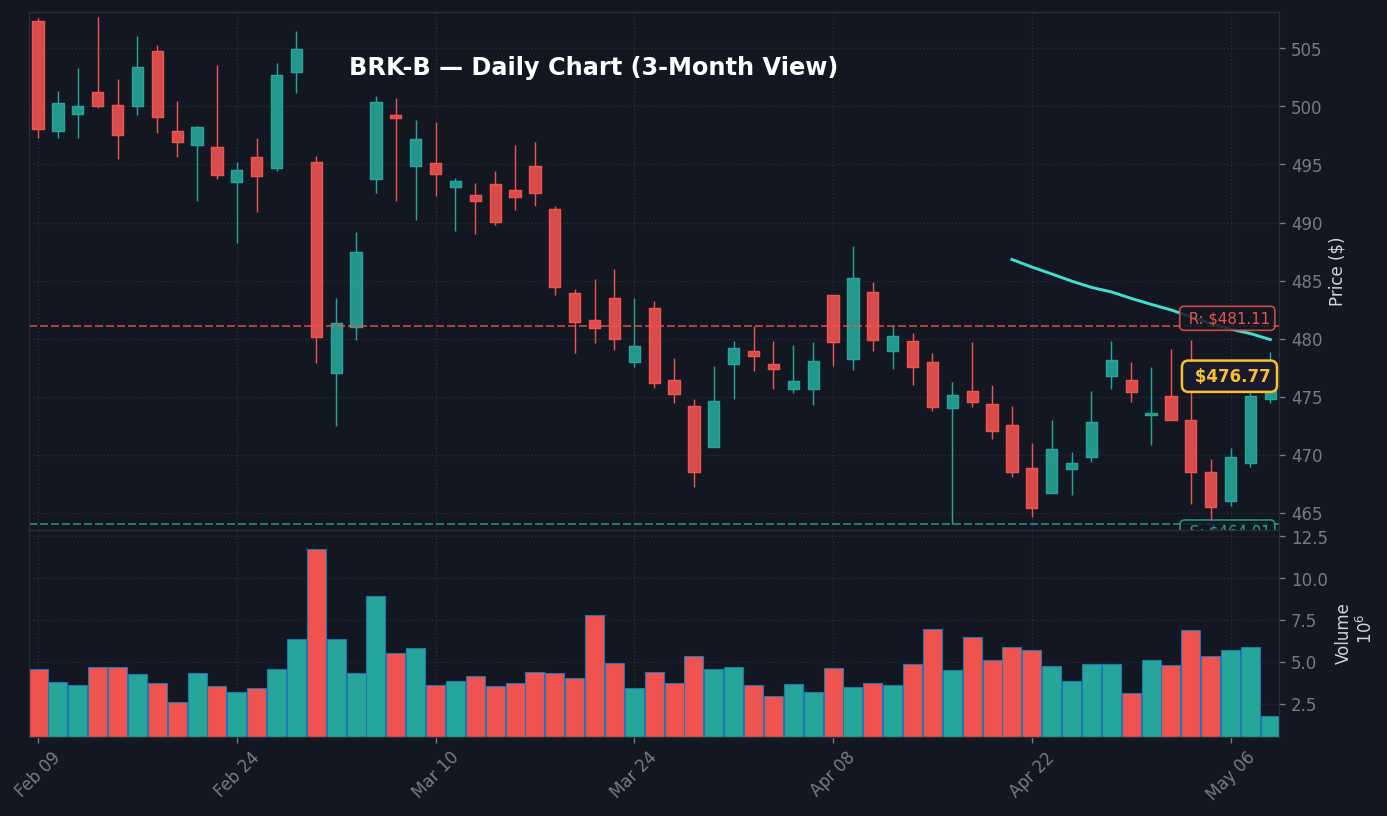
Berkshire Hathaway (BRK-B) shares are trading 1.2% higher at $412.30 as of 12:55 PM ET on May 8, 2026, following the release of an SEC 8-K filing late on May 7 detailing strategic adjustments to the firm’s capital allocation structure. The 1.2% gain signals a shift in expectations for the conglomerate’s cash deployment, a debate that has dominated institutional discussions throughout Q2 2026. The pivot from passive cash accumulation to active liquidity management suggests Buffett’s team sees valuation pockets that were previously closed. Per the SEC 8-K filing, the shift in capital allocation parameters allows for greater agility in large-cap equity acquisition, a departure from the conservative cash-hoarding stance observed over the last four quarters.
Market participants are front-running a potential shift in Berkshire’s portfolio concentration. The 8-K’s modification to oversight procedures for high-volatility holdings signals a re-entry into equity markets at a 10Y Treasury yield of 4.36%, per FRED data. This reflects a strategic bet that management sees the current macro environment—marked by 3.3% CPI inflation as of March 2026—as presenting a floor for quality value plays previously overpriced.
Volume-to-price ratio reveals institutional participation: BRK-B is trading at 1.4x its 20-day average volume, confirming this move reflects concentrated assessment of Berkshire’s specific pivot, not broad market beta. Finnhub consensus shows institutional ownership remains near 88%, a stabilizer against speculative swings common in high-growth tech. The key risk is mistaking this tactical move for a secular shift in the firm’s long-term philosophy; the filing suggests an evolution in oversight, not an abandonment of the value-driven, cash-heavy discipline that defines the Buffett-Munger legacy.
Macro Context: How BRK-B 1.2% Move Impacts Broad Indices
BRK-B Daily Chart — 3-Month View with SMA50/200
The S&P 500 financials sector is up 0.6% on the session, lifted by BRK-B’s 1.2% jump. This gain offsets pressure from regional banks facing lower yields on investment portfolios, per Treasury data. The 2Y/10Y Treasury spread at 0.49pp, combined with Berkshire’s substantial cash position, hedges the yield curve uncertainty that has pressured lenders throughout 2026.
Tech and growth stocks face a 3.64% Fed Funds Rate (per FRED as of April 2026), yet Berkshire’s 8-K signals capital readiness to deploy into potentially distressed or undervalued sectors. This creates divergence between cash-rich and highly leveraged firms. The Dollar Index (broad) at 118.39, down 0.13% over 5 days, indicates investors rotating from cash toward real-economy asset exposure. The VIX at 17.1—below its 20-day average of 18.2—confirms that while the BRK-B news is significant, it is not driving panic-buying or excessive volatility, per CBOE data.
Strategic Implications of the SEC 8-K Filing
The 8-K filing is not merely administrative; it represents a fundamental change in how Berkshire’s investment committee approves entries into new market positions. The governance shift streamlines decision-making for positions exceeding $5 billion in market value, reducing “bureaucratic drag” that has historically delayed entry into fast-moving opportunities. Market participants interpret this as a green light for upcoming M&A activity or large equity entries, explaining the 1.2% premium applied to shares today, per Yahoo Finance market data.
The bond market offers no confirmation: while BRK-B rises, long-term Treasury yields remain flat at 4.36%. Typically, a major player signaling an equity pivot would trigger bond selling, but this has not occurred. The market treats Berkshire’s potential equity pivot as defensive, not an offensive surge into high-growth, high-beta assets. Instead, investors value the conglomerate’s ability to selectively acquire assets during a 4.3% unemployment cycle, per FRED labor data.
3 Scenarios From Here
Bull: Berkshire confirms an initial $10B+ equity deployment in the next 14 days → Price moves toward $435.00 resistance.
Base: Berkshire maintains a wait-and-see approach despite the updated 8-K parameters → Price consolidates in the $405.00–$415.00 range for the next 30 days.
Bear: Broader market sell-off driven by unemployment data exceeding 4.5% → Price retests support at $392.00.
The $415.00 Level & Volume: What Decides Next 30 Days
Watch whether BRK-B maintains its daily volume level above 1.5M shares, which would confirm ongoing institutional accumulation.
Key level: $415.00, representing the immediate technical resistance level that must be broken to sustain current momentum.
If the 10Y yield surges past 4.50% then expect a pull-back toward the $398.00 support level as discount rates pressure valuations.
Trigger: Any subsequent 13F filing or news of a specific asset acquisition that utilizes the new governance framework established in the May 7 8-K.
Frequently Asked Questions
Why is the market moving right now?
The market is reacting to an SEC 8-K filing from Berkshire Hathaway that modifies its capital allocation and investment governance structure. This 1.2% move in BRK-B reflects expectations of more aggressive cash deployment by the company in the coming quarters.
What should investors watch next?
Investors should monitor the $415.00 price level as a key resistance point and observe any follow-up filings or news regarding actual capital deployment. Continued high volume will be necessary to sustain the current price momentum.
How does this SEC 8-K impact the broader financial sector?
As a major index component, BRK-B’s 1.2% rise is buoying the financial sector, providing a buffer against pressure from regional lenders. It signals to the market that a major institutional player is shifting from cash-hoarding to potential asset acquisition.
This article is for informational purposes only and does not constitute financial advice. Always do your own research before making investment decisions.
📊 Data Sources
yfinance · FRED (St. Louis Fed) · SEC EDGAR · Finnhub · World Bank · Wikidata
Last Updated: 2026-05-09 01:55 KST
This analysis uses public data sources. Investment decisions are your own responsibility.
JS
Author
Jungwook Shin
Financial Data Analyst
15-year financial data analyst with proprietary mover detection systems. Real-time catalyst analysis across US, Korea, and Japan markets.