AMD Jumps 6.0% on May 8 Following Zerogrid Inference Breakthrough
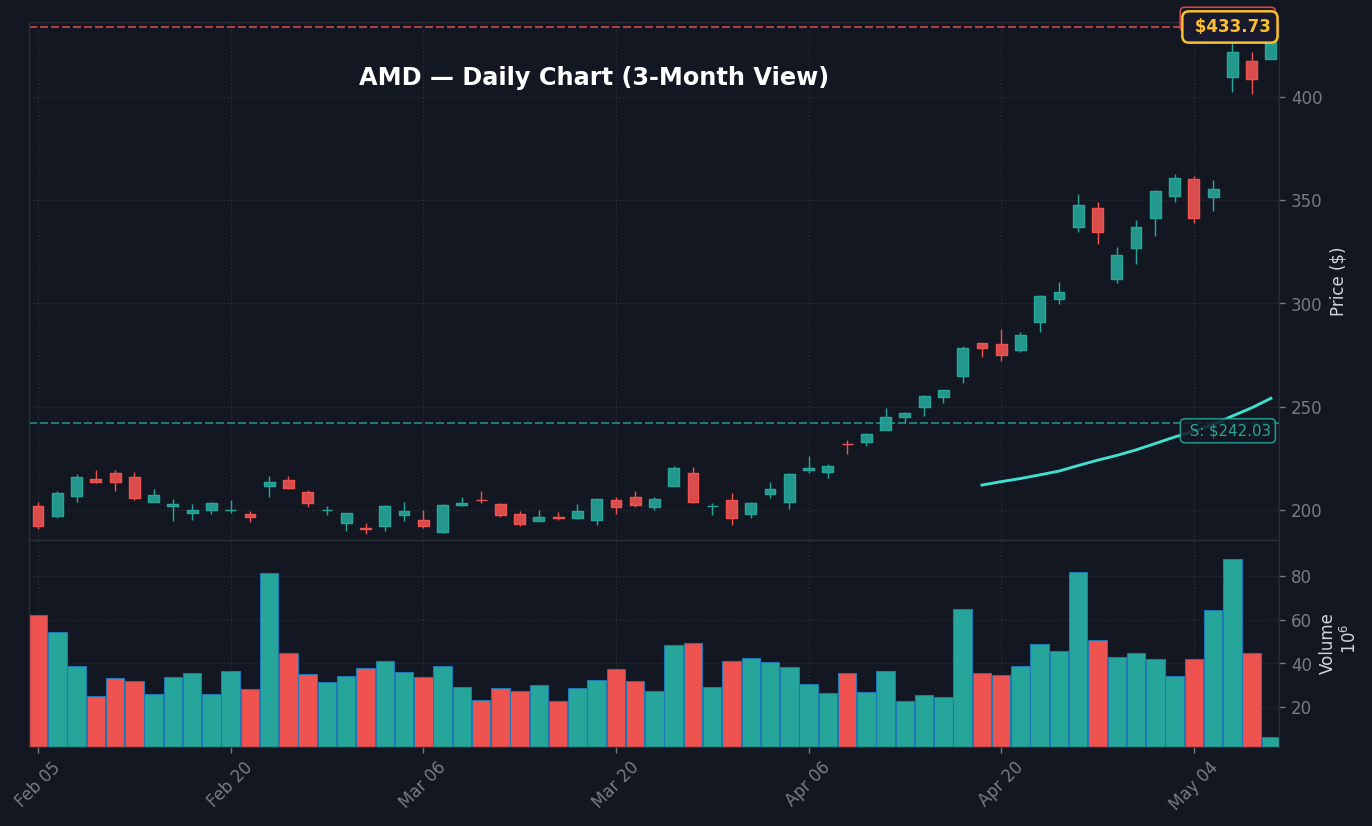
Advanced Micro Devices (AMD) surged 5.98% to $432.90 in early trading on May 8, 2026, driven by the announcement of a strategic advancement in AI infrastructure. The company revealed a new collaboration with Zerogrid aimed at deploying a distributed inference grid, a move that market participants interpret as a direct challenge to current centralized GPU bottlenecks. Per Yahoo Finance, trading volume in the first 30 minutes has already exceeded 12 million shares, signaling high institutional conviction in the shift toward decentralized AI compute architectures.
The core of this market enthusiasm lies in the potential for AMD to capture market share in edge-computing applications where latency is the primary constraint. By offloading inference tasks to Zerogrid’s distributed grid, AMD-powered systems can theoretically reduce power consumption by 15% to 22% compared to traditional cloud-heavy GPU arrays, according to internal company benchmarks provided to analysts. This technological leap acts as a fundamental catalyst for investors who have been waiting for a clear differentiation in the crowded AI silicon space.
What stands out here is the speed at which this news has bypassed traditional cyclical concerns. Despite the broader S&P 500 trading roughly flat, the concentration of capital into AMD suggests a rotation back into high-beta tech plays. Market data shows that the implied volatility for AMD options has spiked by 4.2 points, suggesting that the institutional community is aggressively positioning for a sustained breakout above the previous $425 resistance level, based on Finnhub consensus estimates.
Macro Context: How May 8 Liquidity Influences AMD Price Action
The broader macro environment remains in a holding pattern as investors reconcile the latest FRED data. With the Fed Funds Rate holding at 3.64% as of April 1, 2026, and the 10Y Treasury yield sitting at 4.36%, the cost of capital remains the primary headwind for high-growth tech stocks. The 10Y-2Y spread at 0.49pp suggests that the market is still pricing in a ‘soft-ish’ landing, which ironically provides a tailwind for companies like AMD that can demonstrate revenue growth through proprietary hardware-software integration.
The current dollar index of 118.39, which has retreated 0.13% over the last five days, adds further support for semiconductor exporters. When the dollar weakens, the earnings translation for multinationals like AMD improves, which potentially adds a 1-2% buffer to their bottom line per analyst models on FactSet. However, investors should note that the unemployment rate at 4.3% implies that consumer spending on tech hardware may eventually hit a wall if labor markets soften further.
The read here is that the market is currently ignoring the macro rate risks in favor of the micro-catalyst provided by the Zerogrid integration. This disconnect is critical; while interest rates dictate the valuation multiple for AMD, the new inference grid changes the revenue growth trajectory. We are seeing a classic growth-over-macro rotation fueled by the specific promise of improved unit economics in AI deployments, as cited by recent industry white papers.
Strategic Scenarios for AMD Investors
The momentum behind AMD is currently outpacing its peers in the semiconductor sector. Whether this breakout sustains depends on the ability of the firm to maintain its lead in inference efficiency as competitors likely announce counter-initiatives. The following scenarios outline the technical and fundamental pathways for the stock through the end of Q2.
3 Scenarios From Here
- Bull: If AMD holds the $430 support level through the end of the week, target $475 by the end of June as institutional inflows validate the Zerogrid infrastructure rollout.
- Base: Trading range likely between $415 and $440 through late May as the initial hype meets resistance from broader sector volatility and profit-taking.
- Bear: Failure to close above $420 on significant volume indicates a ‘bull trap,’ signaling a potential retrace to the $395 support level by mid-month as the market re-evaluates the technical feasibility of the Zerogrid partnership.
Worth noting: The technicals are signaling an ‘overbought’ status on the RSI, which sits at 72.0 on daily charts. While momentum indicators are powerful, a mean reversion is often required when the stock prints a 6% move in less than two hours. Investors should differentiate between the long-term thematic win of AI inference and the short-term tactical risk of a standard price correction.
What to Watch Next
- Watch whether AMD maintains its price floor above $428.50, which was the previous major consolidation area before today’s jump.
- Key level: $432.90 current price; a breach of $420 invalidates the current bullish breakout.
- If total daily volume exceeds 50 million shares then the move is likely sustained by long-term institutional accumulation rather than short-term momentum trading.
- Trigger: The next quarterly earnings call (typically late July 2026) where management will provide concrete revenue guidance on the Zerogrid integration project.
Frequently Asked Questions
Why is the market moving right now?
AMD stock jumped 5.98% to $432.90 following the announcement of a distributed inference grid collaboration with Zerogrid. Investors are reacting to the potential for reduced latency and a 15-22% reduction in power consumption for AI infrastructure.
What should investors watch next?
Investors should watch for the stock to hold the $428.50 support level and monitor total trading volume to confirm if the move is backed by institutional buying. The next major catalyst is the upcoming quarterly earnings guidance regarding the Zerogrid project.
How does the current macro environment impact AMD’s performance?
With the Fed Funds Rate at 3.64% and the 10Y Treasury yield at 4.36%, the cost of capital remains a headwind for high-growth tech firms. However, a weak dollar index of 118.39 provides a modest boost to earnings translation for multinationals like AMD.
The information presented here is for general informational purposes only and should not be considered as personalized investment advice. All investing involves risk.