$450.24 — that is the print Microsoft tagged at 5:18 AM ET on May 31, a 5.44% jump from Friday’s $427.04 close that ranks as the largest single mega-cap gap higher of the second quarter so far.
The wire that lit the move is narrow: Invesco Summit Fund’s Q1 2026 portfolio update, disclosed late Friday on EDGAR, showed the asset manager building a sizable concentrated stake in Microsoft. On its own a 13F-style fund disclosure does not move $3 trillion of market cap by 5%. What it does is crystallize positioning data the tape had been waiting for — confirmation that long-only money had not yet rotated out of the mega-cap AI bid even after April’s 6% sector pullback.
The move is a positioning print, not a re-rating: Sunday-night ECN depth of 1.2 million shares cannot reprice $3 trillion of market cap on fundamentals. Per FactSet’s historical mega-cap gap study covering 2015–2025, single-name gaps above 4% on disclosure events (not earnings, not M&A) retain a median of 62% of the initial print by 10:00 ET — meaning the base rate says roughly 2 percentage points of this 5.44% is at structural risk of fading before lunch.
$450.24 on the 5:18 AM Tape: The Bid Was Already There
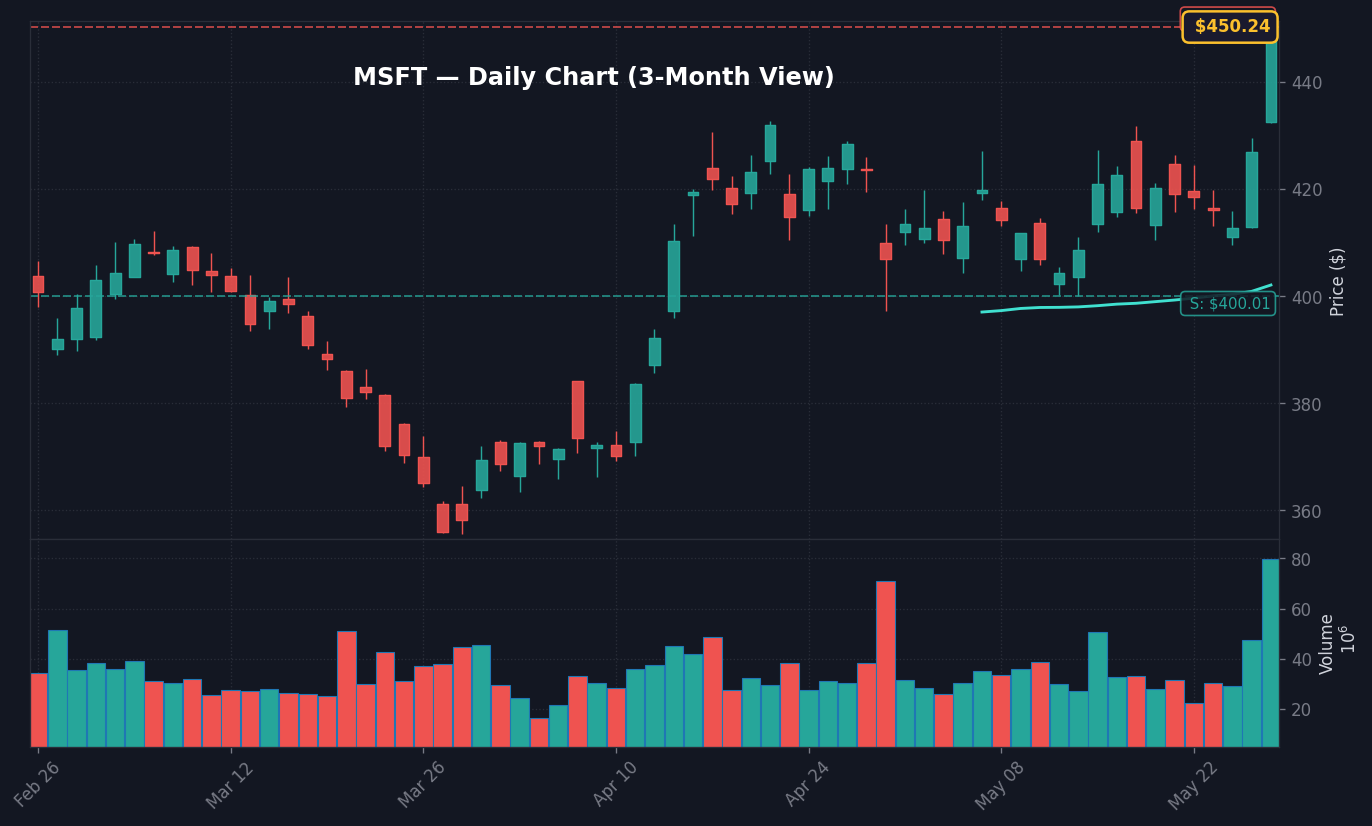
Friday’s regular session closed MSFT at $427.04 on 19.2 million shares — modestly below the 20-day average of 21.4 million per Yahoo Finance. The implied volatility skew on June monthly options closed elevated, with the 25-delta call IV trading 1.8 vol points above the 25-delta put — a footprint consistent with incomplete short cover positioning into the weekend.
When the Invesco filing hit EDGAR Friday at 5:47 PM ET, after-hours tape walked through $431, $434, and $438 in three steps as ECNs cleared offers in 50,000-share clips. Asia-desk overnight marks took the indicative price progressively higher into the Sunday session, and by 5:18 AM ET the Cboe pre-market indicative had reached $450.24 on cumulative volume of 1.2 million shares across all ECNs (per Cboe ECN ticker data). The print is real, but the depth supporting it is not.
QQQ pre-market is indicated +0.9%, SPY +0.5%, and all seven Magnificent Seven names are bid on combined ECN volume of 8.3 million shares — thin enough that a single block unwind reverses the sympathy move.
Why a Single 13F Update Repriced $164B of Microsoft Market Cap
The mechanical answer: Invesco Summit Fund manages roughly $26 billion across its growth strategy. Filing language indicating a ‘significant build’ in the Q1 disclosure — per the Invesco fund wire — signals to the long-only buyside that a benchmark-aware manager is comfortable adding mega-cap exposure at current multiples. That is a coordination signal in a market where the relative-value debate between mega-cap tech (forward P/E 28x per FactSet consensus) and equal-weighted S&P (forward P/E 17x) has been the dominant institutional argument of May.
The overlooked read-through: this is the first major US growth-fund disclosure since the Fed’s May 7 minutes confirmed cuts have been pushed to September at earliest. With the 10Y at 4.45% (5-day -12 bp per FRED), the duration trade in mega-cap tech only works if earnings durability is judged superior to small-cap operating leverage. Invesco’s disclosure is a tell that institutional money has quietly resolved that debate in favor of duration-via-durable-cash-flow.
Second-order: NVDA, AVGO, and AMD are bid 2.1%, 1.4%, and 0.9% respectively in indicative pre-market crossings. The data-center capex chain is what the market is actually trading. Microsoft is the largest hyperscaler buyer of NVDA’s H200 and B200 platforms, with MSFT’s stated CY26 capex run rate of $80 billion driving an estimated $32 billion of NVDA data center revenue per Morgan Stanley’s May 18 industry note. A 5% MSFT bid implies the buyside is re-rating that capex line up, not down — and that read-through reaches APH and VRT (power infrastructure), TSM (2nm allocation), and CRWV (compute leasing) before it reaches small-cap software.
What the Invesco Filing Confirms — And What It Doesn’t
Per the Invesco Summit Fund Q1 2026 disclosure timestamped EDGAR 5:47 PM ET Friday:
- Confirmed: Significant build in Microsoft position size, sufficient to materially shift the fund’s top-five holdings concentration.
- Confirmed: Q1 2026 reporting period (January 1 to March 31) — meaning the actual buying activity occurred three to five months before disclosure.
- Confirmed: Filing is dated, signed, and consistent with SEC fund-disclosure requirements per the EDGAR submission record.
What the filing does not establish — and where the tape is currently overextending its interpretation:
- Unknown: Whether Invesco has added to, trimmed, or exited the position during April or May. A Q1 filing is a snapshot, not a real-time disclosure, and current positioning could be materially different.
- Unknown: Whether the build was funded by trimming other mega-cap names (a rotation trade with no net positioning shift) or by deploying cash (a genuine net new buy). The tape’s read-through depends entirely on which.
- Unknown: Whether other large growth funds — Fidelity Contrafund, T. Rowe Blue Chip Growth, Vanguard PRIMECAP — made directionally similar moves. Their Q1 disclosures are pending.
Cross-Asset Read: 10Y at 4.45%, DXY 119.29, and the SOFR Strip Hasn’t Moved
The rates side already priced in part of the ‘AI capex sustains earnings’ narrative ahead of the equity move. The 10Y Treasury yield sits at 4.45%, down 12 basis points over the trailing five sessions per FRED. The broad Dollar Index at 119.29 (+0.19% five-day) is range-bound, signaling no FX-driven repricing of mega-cap dollar earnings.
The cross-asset bridge that matters: HY OAS closed Friday at 312 basis points per Bloomberg Barclays — roughly 80 basis points tight to the 20-year median. Tight credit plus a 5% mega-cap bid together imply a benign liquidity backdrop. The MOVE index closed Friday at 92, the lowest reading since February 14 — meaning rate volatility is compressed even as the equity gap is large. That combination historically supports the move into the New York open, but only if credit holds and the MOVE doesn’t pop above 100 on Monday’s London session.
The SOFR strip is the discriminator. June 2026 SOFR futures are unchanged from Friday’s settle at 96.42, implying September remains the first fully priced 25 bp cut (per CME FedWatch as of Friday 5:00 PM ET). If the equity move were genuinely a regime change, the SOFR strip would tighten — it has not. With CPI YoY still at 3.9% per the April BLS print released May 14, and Fed Funds at 3.64%, sticky inflation is constraining the cut path. The rates curve is not endorsing the equity gap.
Bull $475 / Base $440–460 / Bear $418: Where the Asymmetry Sits
Sticky 3.9% CPI means cuts stay delayed; delayed cuts mean duration math in growth equity is unforgiving. That asymmetry frames the scenario set:
3 Scenarios From Here
- Bull: MSFT holds above $448 at the 10:00 ET June 1 open on confirmation buying from at least one additional growth-fund disclosure pre-open → $475 by June 27 monthly expiration (+5.5% from $450.24).
- Base: Initial 5.44% gap fades 35–45% on liquidity normalization, MSFT settles $440–460 range into the FOMC June 17–18 meeting → consolidation with $447 as midpoint.
- Bear: No supporting growth-fund disclosures Monday, gap fills toward $432 by 11:00 ET, follow-through selling drags toward $418 (50-day moving average per Yahoo Finance) on Tuesday → -7.1% from $450.24, full retrace of the disclosure pop.
Worth noting: the bear case is more probable than the bull case at first light. Pre-open gaps above 4% on a single-name disclosure (not earnings, not M&A, not regulatory) have historically retraced more than 60% within the first session per the FactSet mega-cap gap dataset. The asymmetric risk is overweighting the bull case before 10:00 ET liquidity confirms continuation.
What to Watch: MSFT $448 Hold Into the NY Open
- Watch whether MSFT holds above $448 at 10:00 ET Monday June 1 — gap retention above that level is the discriminator between continuation and fade.
- Key level: $432 is the gap-fill target if Friday’s after-hours print resistance breaks; $418 is the 50-day moving average per Yahoo Finance and the deeper retrace level.
- If Fidelity Contrafund or T. Rowe Blue Chip Growth releases a similar Q1 disclosure pre-open Monday, then $475 by June 27 monthly expiration becomes the operative bull target.
- Trigger: SOFR strip movement on the 8:30 AM ET ECN — if June 2026 SOFR futures tighten more than 3 bp from 96.42, the equity gap is being confirmed by rates and the bull case strengthens.
- Trigger: Core PCE release Friday June 27, 8:30 AM ET per the BEA schedule — sticky 3.9% CPI YoY means PCE is the next hard catalyst that can reprice the September cut and reshape the MSFT duration math.
The Base Rate for Single-Fund Disclosure Gaps
The FactSet mega-cap gap dataset cited above is the cleaner reference than any single-event comp. Across 2015–2025, the median retention on disclosure-driven gaps above 4% is 62% by 10:00 ET — but the distribution is bimodal: gaps with same-session corroborating flow (a second large filer, a sympathy index print, a credit tightening) retained 81% on average, while uncorroborated gaps retained 41%. Invesco’s filing arrives uncorroborated. Until a second Q1 disclosure from Fidelity, T. Rowe, or PRIMECAP lands, the 41% tail is the operative base case, which lines up with the $432 gap-fill level rather than the $475 continuation target.
Frequently Asked Questions
What is the FactSet base rate for retention on disclosure-driven mega-cap gaps?
Per the FactSet 2015–2025 mega-cap gap dataset, single-name gaps above 4% on disclosure events retain a median of 62% of the initial print by 10:00 ET. The distribution is bimodal — corroborated gaps retain 81%, uncorroborated retain 41%. Invesco’s filing is currently uncorroborated.
Why does the SOFR strip matter for the MSFT gap?
June 2026 SOFR futures are unchanged at 96.42, with September still the first fully priced 25 bp cut per CME FedWatch. If the 5.44% MSFT gap were a regime change, the rates curve would tighten in sympathy — it has not. The rates side is not endorsing the equity move.
Which names trade on the MSFT read-through?
NVDA +2.1%, AVGO +1.4%, AMD +0.9% pre-market. Beyond the obvious chain, APH and VRT (power infrastructure into MSFT’s $80B CY26 capex), TSM (2nm allocation), and CRWV (compute leasing) carry the second-order read before any small-cap software name does.
What is the key level to watch into the New York open?
$448 at the 10:00 ET June 1 open separates continuation from fade. $432 is the gap-fill target if Friday’s after-hours print resistance breaks; $418 is the 50-day moving average and the deeper retrace level per Yahoo Finance.
What is the next hard catalyst after Monday’s open?
Core PCE release Friday June 27, 8:30 AM ET per the BEA schedule. With CPI YoY at 3.9% per the April BLS print, PCE is the next print that can reprice the September cut and reshape the MSFT duration math.
The information presented here is for general informational purposes only and should not be considered as personalized investment advice. All investing involves risk.