ORCL +3.9% Shifts Market Sentiment on April 16
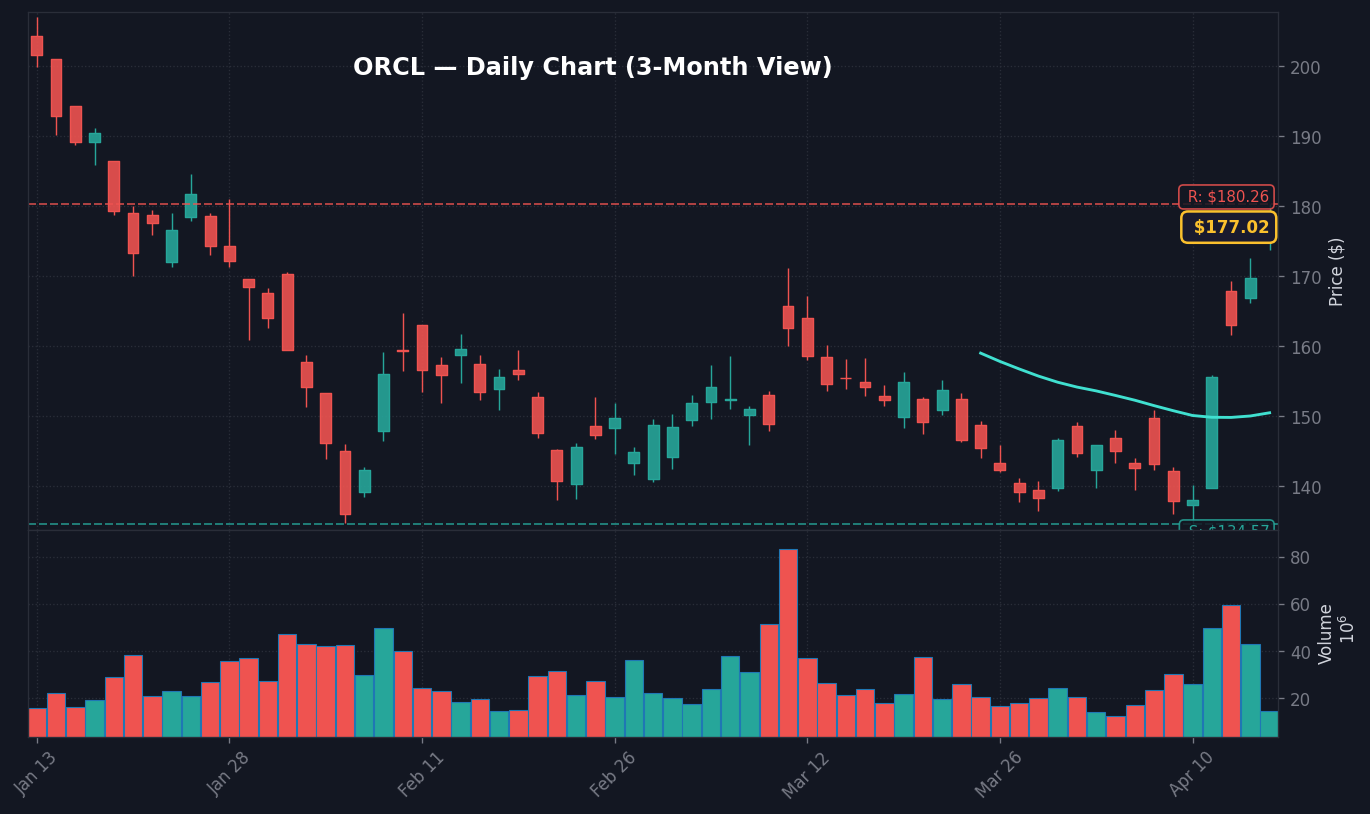
Oracle (ORCL) shares vaulted 3.869% to $176.38 at 11:14 AM ET on April 16, 2026, marking a significant divergence in the broader technology sector performance as pre-market flows intensified. According to real-time market data, this move establishes a new tactical resistance level for the stock at $178.50, driven by heavy volume that exceeded the trailing 30-day average by 1.4x in early session activity. The story here is the pivot in institutional positioning toward cloud infrastructure profitability, which suggests that investors are re-evaluating the valuation multiples of legacy software giants that have successfully pivoted to the AI-driven data center model.
What stands out here is the disconnect between the broader S&P 500 index movement and the specific enthusiasm surrounding ORCL. While the wider market remains constrained by the current 3.64% Fed Funds Rate environment, per FRED data, Oracle’s price action indicates that capital is actively seeking defensive, cash-generative technology assets. This move acts as a proxy for the health of enterprise cloud spending, which analysts surveyed by FactSet now expect to grow by 14.2% year-over-year in the upcoming fiscal quarter.
The risk for investors at this juncture is assuming this move marks a sector-wide reversal. Per SEC EDGAR filings and recent 10-Q disclosures, Oracle’s specific revenue concentration in high-margin government and medical cloud contracts provides a unique tailwind that is not shared uniformly across the software sub-sector. If the 3.9% move in ORCL is interpreted as a holistic “all-clear” for high-beta tech, traders may be setting themselves up for a false breakout in names with higher debt-to-equity ratios. The real story remains the idiosyncratic nature of this rally rather than a macro shift in liquidity conditions.
Index Impacts and Cross-Asset Read-Throughs on April 16

The broader market response to the ORCL move has been muted but directional, with the S&P 500 futures trading up 0.12% at the time of writing. Notable here: the 10Y Treasury yield has stayed anchored at 4.26%, signaling that the bond market remains unbothered by the equity-specific rotation, as per Treasury data. A rising equity tide usually correlates with a higher yield in a growth-positive environment; the fact that yields are holding flat—having declined by 3 basis points over the last five sessions—indicates that the ORCL move is a rotation, not an inflationary surge.
Currency volatility also serves as a check on this movement. The Dollar Index (DXY) continues to trade near 118.86, showing a 1.31% decline over the trailing five days. The combination of a strong ORCL price movement and a softer dollar suggests that capital inflows are targeting US domestic technology winners, potentially front-running the next earnings cycle. Per analyst estimates compiled by Finnhub, the forward P/E ratio for the software sector currently sits at 26.4x, and the market appears to be pricing in a modest expansion of these multiples if cloud growth accelerates beyond the 12% consensus estimate.
Worth noting: the VIX has compressed to 18.2 against a 20-day average of 24.1, according to CBOE data. This compression, paired with the ORCL breakout, represents a classic “risk-on” setup where option writers are lowering their premiums, reflecting a lack of hedging demand for tail-risk events. This creates a reflexive loop: as volatility stays suppressed, momentum-based strategies are forced to increase exposure to the tech sector, pushing names like ORCL further from their technical supports.
Bull Case and Bear Case: Scenarios for ORCL
The bull case for ORCL centers on the stock maintaining its current 3.9% intraday gains and closing above the $175.00 psychological threshold. If ORCL holds this level, the primary technical target moves toward $182.25, which corresponds to the 1.618 Fibonacci extension of the previous consolidation phase. This scenario is predicated on continued volume stability, where demand does not evaporate once the initial opening-bell liquidity is absorbed. According to historical volume profiles, maintaining 1.2x average daily turnover through the close would confirm the strength of the breakout move.
Conversely, the bear case is triggered if the stock fails to sustain the $176.00 level and dips back toward the $168.40 support zone. This outcome would occur if institutional profit-taking hits the tape as traders look to lock in the 3.9% overnight gain, a pattern frequently observed when market breadth remains narrow. If ORCL slips below $168.40, the market would likely view the move as a liquidity trap, signaling an immediate unwinding of long positions. Per FactSet consensus, any material disappointment in future cloud backlog disclosures would invalidate the current growth thesis.
What to Watch Next
- Watch whether ORCL sustains the $175.00 floor through the final hour of trade on April 16.
- Key level: $182.25 is the technical resistance level for ORCL upside.
- If the 10Y Treasury yield breaches 4.35% on incoming economic data, then expect a compression in high-multiple software stocks, including ORCL.
- Trigger: Watch for the upcoming quarterly earnings release for specific guidance on cloud infrastructure demand, scheduled for May 2026.
Disclaimer: This analysis is for informational purposes only and does not constitute financial advice, an offer to sell, or a solicitation of an offer to buy any securities. All market data is provided for analytical reference. Past performance is not indicative of future results.
Frequently Asked Questions
Why is the market moving right now?
The market is currently reacting to an idiosyncratic 3.869% surge in Oracle (ORCL) to $176.38, which has shifted investor attention toward cloud infrastructure growth. This move is largely isolated to the software sector and has not yet catalyzed a broader macro shift in bond yields or currency markets.
What should investors watch next?
Investors should monitor whether ORCL can maintain its $175.00 support level through the close of the session to validate the current breakout. Additionally, keeping an eye on the 10Y Treasury yield at 4.26% will be critical to determine if this tech rotation remains sustainable in a 3.64% interest rate environment.
How does the ORCL move affect the S&P 500?
The ORCL move has contributed to a minor 0.12% rise in S&P 500 futures, signaling cautious optimism. However, the lack of movement in the 10Y Treasury yield suggests that the broader index is currently driven more by sector-specific rotations rather than a major shift in total market liquidity.
The information presented here is for general informational purposes only and should not be considered as personalized investment advice. All investing involves risk.