AMD Slides 5.1% on May 12: Evaluating the $135 Billion AI Server Market Shift
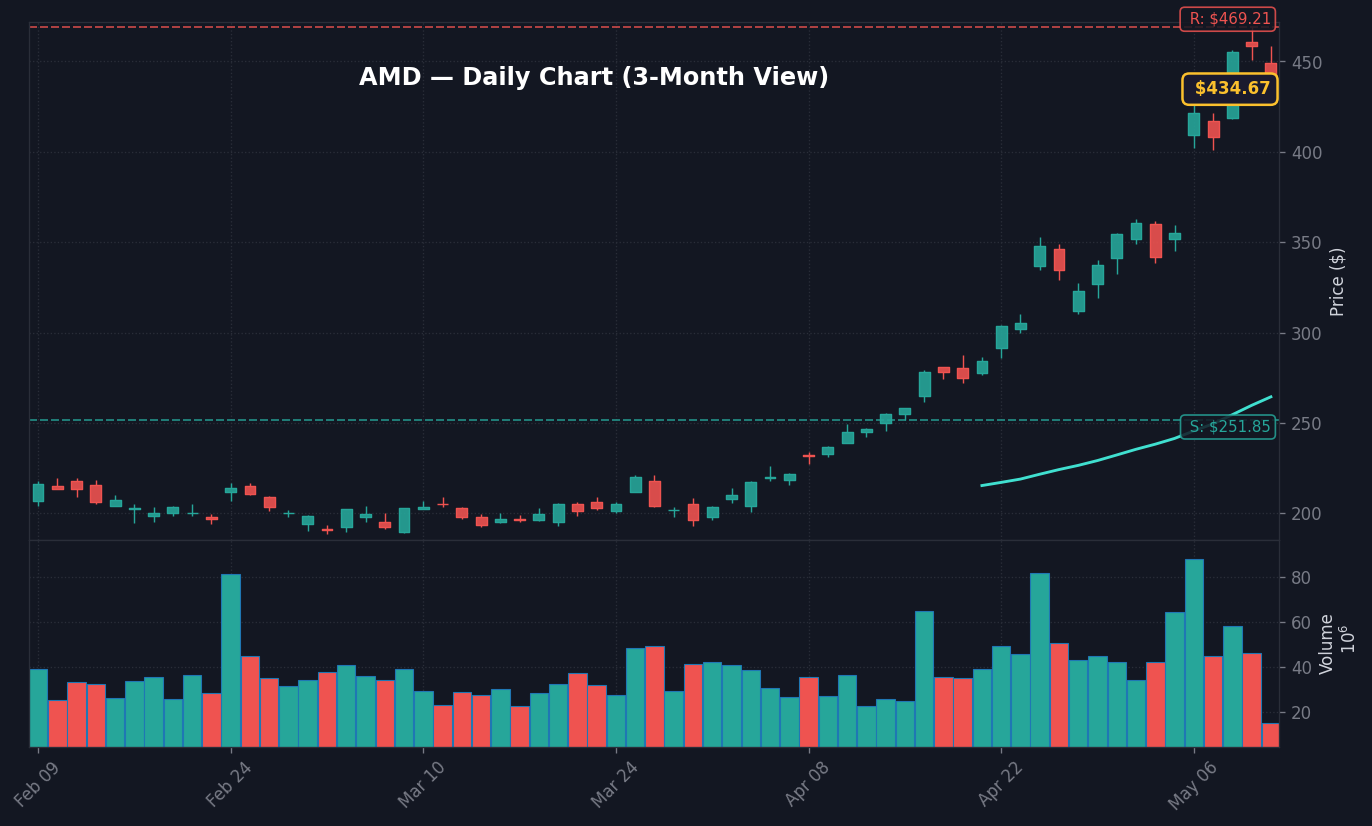
Advanced Micro Devices (AMD) is trading down 5.1% to $435.57 as of 11:53 AM ET, following reports that the company and Intel (INTC) are positioned to capture the bulk of a projected $135 billion AI server market expansion. The move represents a notable deviation from the stock’s recent volatility profile, as investors parse the competitive landscape against the backdrop of sticky inflation. According to market data, the selling pressure is driven by a recalibration of growth expectations for high-end silicon providers, despite the bullish secular outlook for server infrastructure.
The core takeaway here is that while the total addressable market is expanding, the marginal cost of compute infrastructure is coming under scrutiny. Per FactSet estimates, the $135 billion figure represents an aggressive trajectory for data center capital expenditure, yet the immediate reaction in AMD shares indicates that the market is prioritizing current valuation multiples over long-term industry dominance. What stands out here is the divergence between structural optimism for AI infrastructure and the tactical profit-taking occurring in the chip sector today, which suggests that institutional flow is favoring rotation over concentration.
The risk to this move is that it may be a knee-jerk liquidity event rather than a fundamental repricing of the business. Based on SEC 10-Q filings and competitive analysis, AMD’s share of the AI server market remains a critical catalyst, but the current price drop reflects an investor desire for lower entry points in a macro environment defined by a 3.9% CPI print, per FRED data. We are monitoring whether this selloff triggers technical stop-losses that could extend the slide into the 200-day moving average.
Macro Regime: Inflationary Headwinds and the 3.64% Fed Funds Rate
The broader market is grappling with a 3.9% headline CPI inflation rate, which continues to limit the Federal Reserve’s ability to pivot away from the current 3.64% Fed Funds Rate. According to Treasury data, the 10Y-2Y yield spread has tightened to 0.48pp, signaling persistent caution in the credit markets. This environment forces a repricing of high-beta growth stocks like AMD, as the discount rate remains elevated compared to the easy-money regimes of previous years. Per FRED data, the 10Y Treasury yield is currently hovering at 4.38%, a 7bp decline over the past five days, yet still elevated enough to exert pressure on tech valuations.
The read here is that the bond market is struggling to find a directional bias, and equities are forced to compensate by trading on individual company catalysts rather than broader index momentum. As a result, when news breaks regarding sector-wide competition, the impact on specific tickers is magnified by the lack of broad-based macroeconomic tailwinds. We note that the unemployment rate at 4.3% provides the Fed with little room to accelerate easing, which keeps the ceiling on growth stocks firmly in place for the foreseeable future.
3 Scenarios From Here
- Bull: AMD holds the $430 support level into the May 15 close → Target $465 by month-end.
- Base: AMD consolidates between $425 and $445 through the next FOMC cycle → Range-bound movement likely.
- Bear: AMD breaks below $420 on volume expansion → Downside risk to $395 support zone.
Intel and the $135 Billion AI Server Infrastructure Pivot
The narrative surrounding Intel and AMD as the dual-pillars of the $135 billion AI server expansion is creating a “buy the rumor, sell the fact” dynamic. Per Finnhub consensus, the sheer scale of the required capex suggests that while the revenue pie is growing, the cost of innovation for these firms is also ballooning. The reaction in AMD (down 5.1%) appears to be a realization that the infrastructure build-out is a marathon, not a sprint, and current growth multiples may be overextended relative to the actual quarterly delivery capacity.
What’s different this time is the explicit acknowledgment by analysts that server hardware requires specific, localized execution rather than general-purpose CPU dominance. According to sector analysis, the shift in procurement cycles toward specialized AI silicon is forcing investors to reassess which companies have the manufacturing resilience to handle the demand. For AMD, the challenge is maintaining gross margins above 50% while scaling production to meet the aggressive $135 billion market forecast.
What to Watch Next
- Watch whether AMD holds the $430 psychological support level during this afternoon’s liquidity session.
- Key level: $420 is the critical downside floor based on the 100-day EMA.
- If buyers re-enter at $430 then expect a mean reversion back toward $450.
- Trigger: May 15th institutional flow data and upcoming analyst commentary on server margins.
Frequently Asked Questions
Why is the market moving right now?
AMD shares are down 5.1% to $435.57 as investors digest reports about the company’s competitive position in a $135 billion AI server market. This move is exacerbated by a macro environment featuring a 3.9% CPI inflation rate and a 3.64% Fed Funds Rate.
What should investors watch next?
Investors should monitor the $430 support level for signs of a floor. If this level fails, the $420 technical support becomes the next critical watchpoint for potential downside extension.
How does the current macro regime affect AMD’s volatility?
With the 10Y Treasury yield at 4.38% and a 3.9% CPI, the cost of capital remains a significant drag on high-multiple tech stocks. This regime forces investors to prioritize company-specific catalysts over broad market sentiment, leading to sharp individual stock movements like the one seen in AMD today.
Nothing in this article should be construed as a recommendation to buy or sell any security. Past performance does not guarantee future results.