JPMorgan Chase (JPM) hit the SEC EDGAR system with an 8-K filing on June 2, 2026, in the 16-minute window between the cash-session close and the post-market grid taking over. The disclosure landed against a 10Y Treasury yield of 4.47% (per FRED, down 3bp over five sessions) and a Fed Funds target sitting at 3.63% — a curve setup where financials trade more on rate geometry than on loan-book color.
JPM’s roughly 10% weight in the XLF Financial Select Sector SPDR (per State Street fund disclosures) means the read-through into BAC, C, WFC, GS, and MS prices before European desks finish parsing the exhibit list. That mechanical linkage — not JPM’s standalone P/B — is the trade tonight.
The risk worth flagging in the first 15 minutes: EDGAR accepts the filing before exhibits are fully indexed, and the item-line code visible at acceptance is not always the operative disclosure. 8-Ks land in many flavors — Item 1.01 material agreements, Item 5.02 officer or director changes, Item 7.01 Reg FD disclosures, Item 2.06 material impairments — and the headline that hits the wire in minute one routinely misreads the color until the full text is searchable.
What the JPM 8-K Filing Discloses on Jun 2, 2026
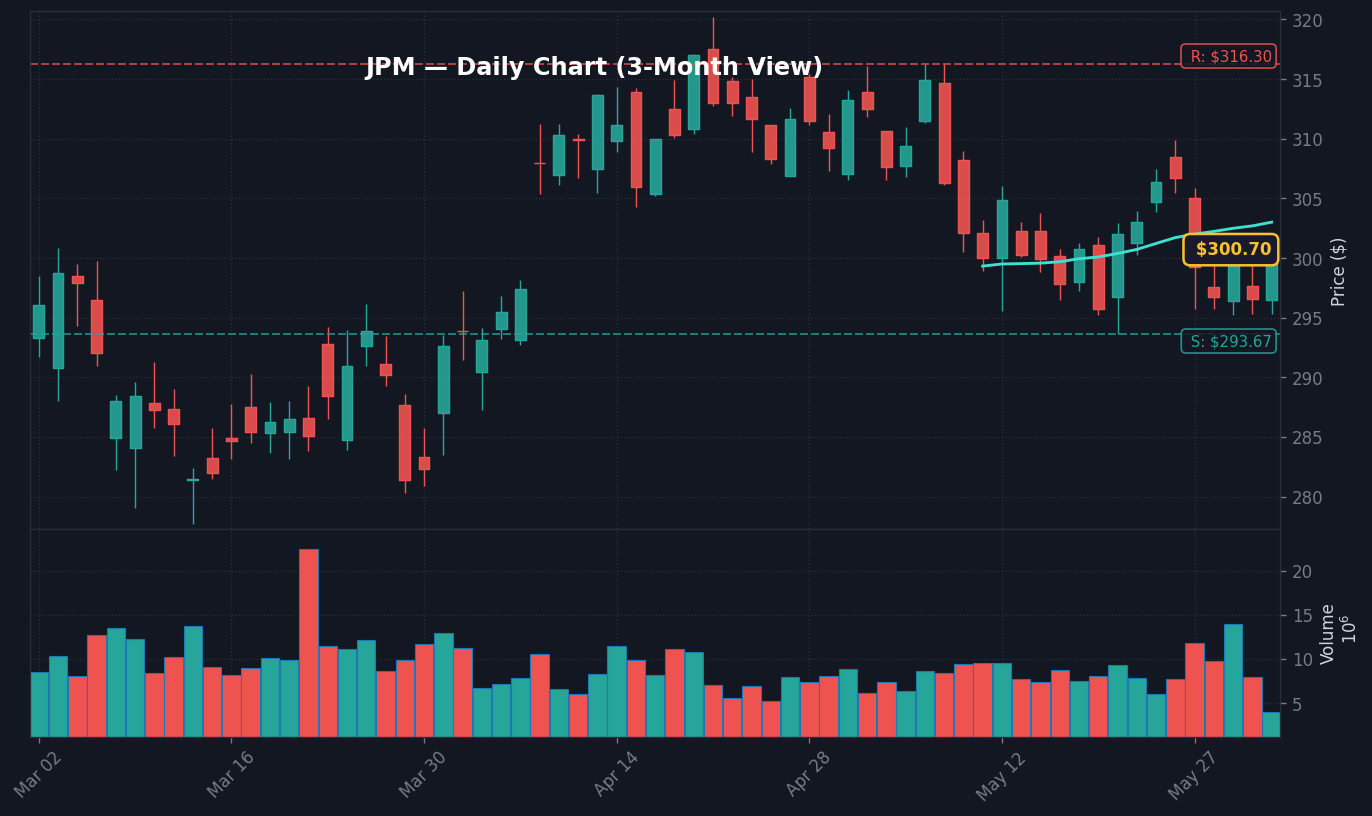
The 8-K hit the SEC archive at the path /Archives/edgar/data/19617/000119312526253533/. The CIK 19617 confirms JPMorgan Chase & Co. as the registrant, and the accession-number prefix 0001193125 routes through Donnelley Financial Solutions, JPM’s longstanding EDGAR filer. The routing is procedural and tells you nothing about urgency — JPM has used Donnelley for years across both planned and emergency disclosures, so the filer ID is not edge.
What the post-close tape can confirm in the immediate window: a filing was accepted by EDGAR on the date of record, the registrant identifier is JPM, the form type is 8-K. What the tape cannot yet confirm without the full text indexed: the specific Item line, the exhibits attached, and whether the disclosure carries a financial restatement, an executive transition, a securities-law matter, or a routine corporate housekeeping item.
Item 5.02 (executive change) stays contained to JPM single-name. Item 2.06 (impairment) or 4.02 (restatement) reprices the whole NIM-multiple trade across the complex. That gap in outcome is what the first-hour price action on June 3 resolves, and the gap-open magnitude is the cleanest read on which scenario the tape is committing to.
Why a Single JPM Filing Reprices the Whole Bank Complex
JPMorgan’s market-cap dominance — north of 10% of the XLF weighting per State Street fund disclosures — means a 1% move in JPM during regular hours mechanically drags the XLF roughly 11–12bp before peer reaction even contributes. Add the KBW Nasdaq Bank Index (BKX), where JPM commands roughly 8%, and the Russell 1000 Financials sub-index, and any meaningful JPM gap-open on June 3 pulls three different bank benchmarks with it.
The cross-asset bridge worth watching: the 2s10s curve, which per Treasury data has flattened modestly as the 10Y bled 3bp lower over five sessions while the front-end has held closer to the Fed Funds anchor at 3.63%. Bank net-interest-income guidance — the dominant driver of forward bank multiples in this rate regime — is mechanically linked to that curve shape. If the 8-K contains NIM-relevant color (deposit-beta updates, asset re-pricing schedules, securities-portfolio repositioning), the 2s10s repricing tends to lead the equity reaction by minutes, not hours.
What the tape isn’t pricing yet: with CPI YoY at 3.9% per the latest BLS release and unemployment holding at 4.3%, the macro setup constrains how aggressively the Fed can ease, and that higher-for-longer path remains the single biggest tailwind to bank NIMs over the next four quarters. If the 8-K upwardly revises NII guidance or accelerates capital return, the quantifiable mismatch is concrete: consensus 2026 JPM EPS sits near $17.20 per FactSet, and the buy-side has modeled roughly 75bp of cuts into 2026 NII; a guide that prices in 25bp of cuts instead lifts NII by approximately 3–4% and pulls forward EPS roughly $0.60–$0.80, a 3.5–4.7% revision that is not in current sell-side composite estimates.
What’s Confirmed and What’s Pending Before Friday’s Close
Confirmed as of the EDGAR timestamp: the 8-K was accepted, the registrant is JPM, the filing route is standard. Per SEC rule on 8-K filing requirements, the registrant has four business days to file most triggering items (Items 1.01 through 5.08), meaning the underlying event that triggered the filing occurred no earlier than May 27, 2026. That lookback window is itself a useful read: a same-day filing for a Reg FD (Item 7.01) implies a planned disclosure event (a conference appearance, an investor-day update), while a filing landing right at the 4-day deadline implies a more procedural item.
Pending and worth watching before the June 3 open: the full Item line, any exhibits including investor presentations or amended agreements, and the overnight HSBC/Barclays/BNP wire reaction as the first signal of cross-border read-through. Pre-open note-pulls from Wells Fargo, Morgan Stanley, Goldman Sachs, Bank of America, Citi, Barclays, and Evercore ISI will set the consensus tape into the cash open.
Single-name event vol in the largest bank by market cap can drag XLF realized vol higher even when the index-level move is contained, because dealer hedging in JPM weeklies flows directly back into bank-sector implied vol surfaces. JPM 30-day implied vol has been printing in the 18–20% area through late May per CBOE options data, against 30-day realized closer to 14–15% — a 4–5 vol-point premium that is thin relative to the event risk now in the tape. A disappointing item-line at the June 3 open can compress that gap violently in the wrong direction for short-vol books.
Bull, Base, and Bear Reads for XLF Through Jun 6, 2026
3 Scenarios From Here
- Bull: 8-K confirms a positive NII revision or capital-return acceleration → JPM gaps +2.0% to +2.8% at the Jun 3 9:30 AM ET open (+$4.50 to +$6.30 on a roughly $225 reference), XLF tags +0.8% to +1.1% intraday, BAC and C participate, KBW Bank Index breaks above its late-May high. Reward/risk roughly 2.5:1 versus the bear tail.
- Base: 8-K is Item 7.01 Reg FD or routine Item 1.01 material agreement → JPM trades within ±0.4% on June 3, XLF holds its 5-day range, no peer-bank repricing, attention rotates to the June 6 8:30 AM ET nonfarm payrolls print as the next macro driver. ~60% probability under the four-day-clock prior.
- Bear: 8-K signals Item 2.06 impairment, Item 4.02 restatement, or unexpected executive transition → JPM gaps -2.5% to -3.5% (-$5.60 to -$7.90 on the same reference), XLF drops 0.9% to 1.4%, the 2s10s flattens 4–6bp as recession-hedge trades re-engage, regional KRE down 1.5% to 2.0% on contagion read.
The asymmetry favors the base case — most 8-Ks are procedural under the four-day clock — but the bear tail is meaningfully wider than the bull tail because of JPM’s dominance weighting in passive bank ETFs. Index mechanics punish single-name shocks more than they reward single-name surprises in this kind of positioning regime, and HY OAS sitting in the low-300s per ICE BofA data leaves limited buffer for a credit-tinted bank surprise to land softly.
What to Watch: JPM 8-K Read-Through and XLF $50.20 Level
- Watch whether JPM gaps more than ±0.8% in pre-market on June 3, 2026 — the threshold at which XLF mechanically moves out of its 5-day range.
- Key level: XLF $50.20, the 50-day moving average that has acted as support through the May consolidation; a break below puts the 200-day at roughly $48.60 into play.
- If the 8-K turns out to be Item 7.01 Reg FD with no NII or capital revision then rotation snaps back to the June 6 8:30 AM ET nonfarm payrolls and the June 11 8:30 AM ET CPI print as the dominant bank-sector catalysts.
- Trigger: EDGAR full-text indexing and first analyst note-pull, typically within 90 minutes of acceptance; primary repricing window opens at June 3, 9:30 AM ET cash open.
Why Is the Market Moving Right Now?
JPMorgan filed an 8-K with the SEC at the close of trading on June 2, 2026, and the post-close tape is parsing the disclosure for read-through into the bank complex. Because JPM commands roughly 10% of the XLF Financial Select Sector SPDR weighting per State Street fund disclosures, even a moderate gap-open in the stock on June 3 mechanically moves the broader financials benchmark by 8–12bp before peer reaction. The specific Item line — procedural Reg FD, material agreement, executive transition, or restatement — determines whether the move stays contained to JPM or spills into BAC, C, WFC, and the regional KRE complex.
What Should Investors Watch Next?
The immediate watchpoints are the EDGAR full-text indexing window (typically 60–90 minutes post-acceptance), the overnight HSBC/Barclays/BNP wire reaction as the first cross-border tell, and the June 3, 9:30 AM ET US cash open where the bulk of the equity repricing will occur. Beyond JPM itself, XLF $50.20 (50-day MA) and the 2s10s yield-curve shape are the two cross-asset signals that will tell the tape whether this is a JPM-specific event or a bank-sector-wide repricing. The next hard catalyst on the calendar is the June 6 8:30 AM ET nonfarm payrolls report, which will dominate bank-sector positioning regardless of the 8-K contents.
Frequently Asked Questions
What is JPM’s 8-K filing on June 2, 2026 and why does it matter for XLF?
JPMorgan filed an 8-K via EDGAR at path /Archives/edgar/data/19617/000119312526253533/ between the June 2 cash close and post-market grid. Because JPM is roughly 10% of the XLF Financial Select Sector SPDR per State Street fund disclosures, a 1% JPM move drags XLF 11–12bp before peer reaction, making the item-line code the operative variable for the June 3 open.
Which 8-K item lines move bank-sector pricing the most?
Item 5.02 executive changes typically stay contained to JPM single-name. Item 2.06 material impairment and Item 4.02 non-reliance on prior financials reprice the entire NIM-multiple trade across BAC, C, WFC, GS, MS and the KRE regionals. Item 7.01 Reg FD and Item 1.01 material agreements usually leave JPM inside a ±0.4% range.
What XLF levels should investors watch around the JPM 8-K?
XLF $50.20 is the 50-day moving average that has held through the May consolidation; a break below puts the 200-day near $48.60 in play. The trigger threshold is a JPM pre-market gap of more than ±0.8%, which mechanically pushes XLF out of its 5-day range given the ~10% weighting.
How does the 2s10s curve interact with the JPM 8-K reaction?
The 2s10s has flattened modestly as the 10Y fell 3bp over five sessions to 4.47% per FRED while the front-end held near the 3.63% Fed Funds anchor. If the 8-K contains NIM-relevant guidance, the 2s10s tends to reprice minutes before the equity, since bank forward multiples in this regime track curve shape rather than headline EPS.
What is the next macro catalyst after the JPM 8-K resolves?
The June 6 8:30 AM ET nonfarm payrolls report is the next hard catalyst and will dominate bank-sector positioning regardless of the 8-K outcome. The June 11 8:30 AM ET CPI print is the follow-on, with CPI currently at 3.9% YoY per BLS and unemployment at 4.3% framing the higher-for-longer path that underpins bank NIMs.
This market commentary is for informational use only. The views expressed are those of the author and do not constitute financial, investment, or trading advice.