META filed a Form 8-K with the SEC on May 29, 2026 — the kind of late-Friday material disclosure that lands into a quiet tape and forces every desk to re-price over the weekend. The filing (per the SEC EDGAR archive at sec.gov/Archives/edgar/data/1326801/000162828026039193/) drops into a configuration where complacency is the larger risk than panic: VIX sits at 15.7 versus a 20-day average of 17.3 per FRED, the 10Y Treasury has rallied 12bp over five sessions to 4.45%, and the broad dollar index is essentially flat at 119.29. None of those macro reads were pricing in a single-name 8-K from the largest communication services constituent. They are now.
The thesis for this note is narrow: the filing itself is confirmed, the contents are not yet parsed by the broader sell-side wire as of 09:58 PM ET on May 30, and the gap that opens at Monday June 1, 09:30 ET will be a function of two things — the substance of what META disclosed and the positioning that has built up under VIX 15.7. Both vectors matter. The key risk is mistaking the first knee-jerk print Monday morning for the full message; in a low-vol regime, the second move usually dominates the first.
What stands out here is the timing. An 8-K filed late on a Friday into a low-VIX, low-yield tape is the configuration where intraday gap risk is structurally highest — not because the news is necessarily worse, but because two full sessions of price discovery get compressed into Monday’s open. Per SEC instructions to Form 8-K, the four-business-day filing window means the underlying triggering event likely occurred between May 26 and May 29. Buy-side desks reading the filing fresh Monday morning will be reacting to the same primary source as the Sunday-evening futures market.
What Form 8-K Disclosed by META on May 29, 2026
Form 8-K is the SEC’s current report — the vehicle issuers use to disclose material events shareholders are entitled to know about between quarterly filings, per SEC Regulation FD. The form has 9 numbered items covering everything from acquisitions (Item 2.01) and material agreements (Item 1.01) to executive departures (Item 5.02) and Regulation FD disclosures (Item 7.01). Without the parsed item header in front of us, the directional read depends on which line of the form META used.
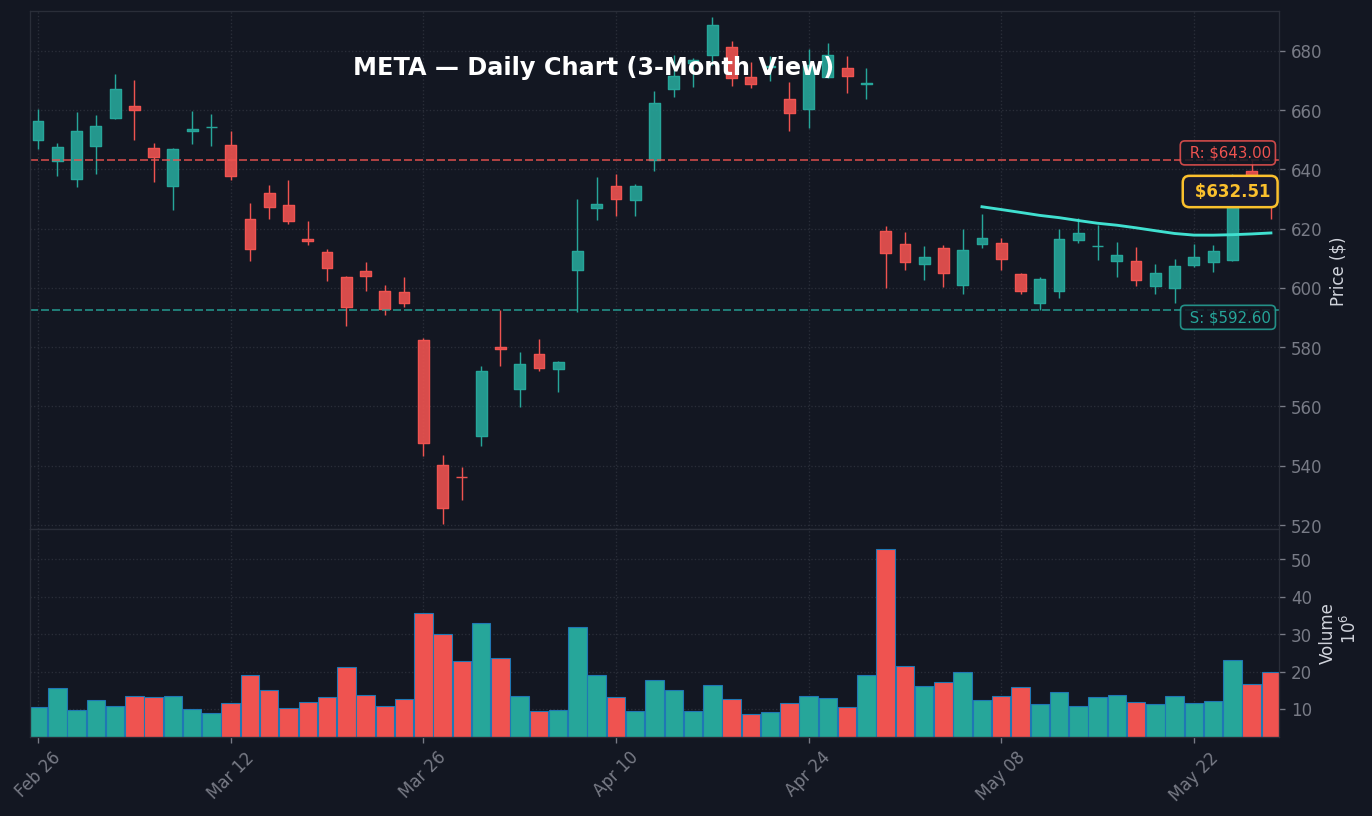
What is confirmed at this hour: the filer is Meta Platforms Inc. (CIK 1326801, per EDGAR’s index), the form type is an 8-K (current report), the filing date stamped by EDGAR is May 29, 2026, and the accession number 000162828026039193 corresponds to a Donnelley Financial filing agent. What is not yet broadly distributed in wire summaries: the specific Item number, the exhibits attached (a press release exhibit under Item 7.01 would be a non-FD disclosure; an Item 2.02 would carry results of operations), and whether the filing includes forward guidance language. Until those parse, the market is trading the form, not the substance.
The overlooked read-through: when a mega-cap files an 8-K between earnings prints, the base-rate distribution skews toward either a material agreement (Item 1.01), a regulatory inquiry disclosure (Item 8.01 — Other Events), or a change in board or officers (Item 5.02). Markets price these three buckets very differently. Item 1.01 strategic agreements tend to gap the stock in the direction of strategic clarity; Item 8.01 regulatory disclosures tend to gap negative on first read and reverse on full parse; Item 5.02 leadership changes resolve sharply once the headline is read in context.
Cross-Asset Reaction Setup Into Monday’s 09:30 ET Open
The macro tape into Monday is constructively positioned for a single-name shock to be absorbed, not amplified — that is the read from the 10Y rally to 4.45% (5-day -12bp per FRED) and the VIX print of 15.7 against a 20-day average of 17.3. Treasury demand is bid, the dollar index at 119.29 has been range-bound for five sessions (+0.19% per FRED), and CPI YoY at 3.9% per the April 1 BLS print keeps the Fed Funds rate anchored at 3.64% with limited room to ease. None of those signals are pointing at risk-off ahead of Monday.
Here is the cross-asset bridge that matters: VIX at 15.7 with the 20-day average at 17.3 implies a vol risk premium that is sub-average, which means option-implied moves on QQQ and XLC into Monday are under-pricing the realized gap distribution from an unread 8-K. When implied vol sits below trailing realized and a discrete event is pending, the asymmetry in next-day option pricing favors gamma buyers, not sellers. That is the technical setup the Friday tape left on the desk.
The disconnect is between the macro tape and the single-name event. Macro is pricing a glide path — Fed Funds at 3.64%, 10Y bid at 4.45%, dollar contained — that says risk assets can absorb idiosyncratic shocks. The single-name event is unread. Communication services (XLC, of which META carries roughly a 20% weight) and the Nasdaq 100 (QQQ, where META sits as a top-five constituent) are the two ETFs where Monday’s first hour will register the filing’s substance. Cap-weighted indices feel a META gap roughly four to five times the equal-weighted equivalent — that is mechanical, not narrative.
Why Markets Care About a Single 8-K From a Top-Six S&P 500 Weight
Per S&P Dow Jones Indices methodology, Meta Platforms is among the top-six S&P 500 weights and a top-five Nasdaq 100 weight. A 5% gap in META at the open translates into roughly 25 to 30 basis points of S&P 500 index move before any sympathy moves across communications, internet retail, or AI infrastructure names. That is the mechanical floor of why a Friday 8-K from a Magnificent Seven constituent matters more than the average filing in the EDGAR queue.
The sticky-inflation regime constrains the upside path. With CPI YoY still at 3.9% per the April 1 BLS release — nearly two full points above the Fed’s 2% target — the rate-cut window for 2026 is narrower than it looked at the start of the year. That means multiple-expansion-led rallies in mega-cap tech face a harder ceiling than they did in 2024. A positive 8-K (a strategic acquisition or a buyback authorization, say) gets less multiple lift than the same disclosure would have at lower CPI prints. A negative 8-K, conversely, gets compounded by the absence of a near-term rate-cut tailwind. The 10Y rally to 4.45% is real but is not a cuts-coming signal — it reads more like a flight-to-quality bid against weekend headline risk.
What the Tape Isn’t Pricing Yet
The non-consensus view: the Sunday-evening futures session (ES, NQ) is where the first parse happens, and the spread between Friday’s 16:00 ET cash close and Sunday 18:00 ET futures reopen is the cleanest single read on the filing’s substance. Most sell-side desks publish their parse Monday before the bell — by then, futures will have already absorbed three sessions worth of weekend reading. The implied move from Friday’s option chain is the right benchmark; if the Sunday futures gap exceeds the at-the-money straddle premium, the market is voting that the 8-K contained material price-sensitive information beyond what the form type alone implies.
Worth noting: the EDGAR filing index lists Donnelley Financial Solutions as the filing agent. Donnelley handles both routine corporate filings and complex M&A or governance disclosures — the agent identity is not a directional tell. The accession-number pattern places this in the higher-volume range of late-month corporate filings, which is normal cadence and not a signal of urgency or stealth distribution.
Bull, Base, Bear Scenarios for Monday’s Open
Bull case: META filing reads as a strategic positive — acquisition, partnership, or capital return authorization. ES futures open Sunday 18:00 ET with a gap above Friday’s cash close, QQQ tracks +0.6% to +1.2%, XLC outperforms by 30 to 50 bp, VIX compresses further toward 14.5, 10Y holds 4.45% as the equity bid keeps duration anchored. Communication services rotation accelerates into mid-week, with GOOGL and SNAP catching sympathy bids of 1-2%. Confirmation marker: META gaps and holds above the open by 11:00 ET Monday.
Base case: Filing is process-oriented (governance disclosure, registration update, board matter). Sunday futures react minimally — ES within ±0.3% of fair value, QQQ opens within Friday’s range, XLC trades in line. The 8-K is a non-event after Monday’s first hour, and the tape returns to its existing macro-driven posture: VIX in the 15.5–17.0 band, 10Y in the 4.40–4.50% channel, DXY 119.0–119.5. Most likely outcome given the base-rate distribution of mega-cap 8-Ks between earnings.
Bear case: Filing discloses regulatory action, material litigation, executive departure, or unexpected guidance reset. META gaps down 3-6% in Sunday futures, QQQ tracks -0.8% to -1.5%, XLC underperforms by 50-80 bp, VIX spikes to 18.5+ on the open, 10Y catches a flight bid back toward 4.40%. Sympathy pressure on GOOGL, NFLX, and the internet ad ecosystem (TTD, PINS, SNAP). Confirmation marker: META fails to recover the open print by 11:30 ET Monday and HY OAS indicates wider risk premia on the day.
What to Watch: META Monday Open and Sunday ES Futures
- Watch whether Sunday 18:00 ET ES and NQ futures reopen within ±0.3% of Friday’s fair value — anything beyond that signals the weekend parse has flagged something material.
- Key level: VIX 17.3 — the 20-day average per FRED. A breach above that on Monday’s open signals the filing was read negatively; staying below means the macro absorption thesis is intact.
- If META opens with a sub-1% gap and holds the first 30 minutes, then the 8-K was routine and the QQQ index drag is negligible into Tuesday.
- Trigger: EDGAR full-text parse of the 8-K Item number and exhibits — typically available within hours of filing acceptance. Read the form, not the headline.
- Second trigger: Sell-side morning notes from META coverage (MS, GS, JPM communication services teams) distributed Monday between 06:00 and 08:30 ET.
- Macro cross-check: 10Y Treasury yield 4.45%, DXY 119.29 — if both move more than 5bp or 0.3% from these baselines on Monday open, the 8-K is intersecting with other weekend developments and the single-name read is no longer clean.
Why Is the Market Moving Right Now?
The market reaction is centered on Meta Platforms’ Form 8-K filed with the SEC on May 29, 2026 — a material current-report disclosure from a top-six S&P 500 constituent dropped into a low-vol Friday tape (VIX 15.7 versus 20-day 17.3 per FRED). The filing’s specific Item number and exhibits drive the directional read; until those parse, the Sunday-evening ES futures session is the first market-priced opinion on the substance.
What Should Investors Watch Next?
Three concrete watchpoints: Sunday 18:00 ET futures reopen levels for ES and NQ (a >0.3% deviation from Friday fair value signals material weekend digest), Monday 09:30 ET cash open for META gap magnitude and recovery within the first 30 minutes, and the VIX 17.3 line as the threshold separating absorbed-shock from systemic-spillover regimes. Cross-check the 10Y yield (4.45% baseline per FRED) and DXY (119.29) to confirm whether the move is META-specific or macro-confluent.
Frequently Asked Questions
What is in Meta Platforms’ Form 8-K filed May 29, 2026?
The filing is confirmed at SEC EDGAR (CIK 1326801, accession 000162828026039193) but the specific Item number and exhibits are the load-bearing details — Item 1.01 (material agreement), Item 5.02 (officer change), Item 7.01 (Reg FD disclosure), or Item 8.01 (other events) each carry very different market implications. Sunday-evening ES futures will price the first parse before sell-side desks distribute Monday morning notes.
How does Meta’s 8-K filing affect QQQ and XLC into Monday’s open?
META carries roughly 20% of XLC and is a top-five Nasdaq 100 weight, so a 5% META gap translates into approximately 25-30 basis points of S&P 500 move and a 1%+ XLC move before any sympathy bids in GOOGL or SNAP. The 10Y at 4.45% and VIX at 15.7 (versus a 20-day 17.3 per FRED) suggest macro headroom to absorb a single-name shock — unless the filing carries cross-sector regulatory implications.
Why is VIX at 15.7 a risk signal heading into Monday’s open?
VIX trading at 15.7 versus a 20-day average of 17.3 means implied volatility is sub-average just as an unread 8-K from a Magnificent Seven name sits in the queue — the option market is under-pricing the gap distribution. When implied vol sits below realized and a discrete event is pending, next-day option asymmetry favors gamma buyers, which means a Monday move outside the at-the-money straddle is more likely than the chain implies.
This market commentary is for informational use only. The views expressed are those of the author and do not constitute financial, investment, or trading advice.