Breaking Market Alert
According to Yahoo Finance, The VIX plunged 21.7% to 20.19 in early trading following reports of an Iran ceasefire agreement, dropping the fear gauge to its lowest levels since before geopolitical tensions escalated in the region. This dramatic volatility collapse triggered a broad risk-on rally, with the S&P 500 surging 2.3% to 6,769 and the Nasdaq jumping 2.9% to 22,657 as investors rapidly unwound defensive positions.
According to Yahoo Finance, What stands out here is the speed and magnitude of the unwind — the VIX hasn’t moved this aggressively lower in a single session since the March 2020 recovery began. The move signals that markets had been pricing significant geopolitical risk premiums that are now being stripped out as ceasefire prospects reduce tail risks around Middle East escalation.
Energy Sector Bears Brunt as Oil Craters 16.9%
According to Yahoo Finance, The ceasefire news hit energy markets hardest, with crude oil plummeting 16.9% to $93.81 as traders priced out war premiums that had been supporting prices. This collapse drove the energy sector down 5.1%, making it the day’s worst performer even as the broader market rallied. Companies like APA (-12.5%) and Marathon Oil (-10.5%) led the sector decline, reflecting how quickly geopolitical premiums can evaporate when tensions ease.
The real story here isn’t just the oil move — it’s how the volatility collapse is rippling across asset classes. Treasury yields fell 1.89% to 4.26% as safe-haven demand evaporated, while gold surged 3.2% to $4,806 as investors rotated into traditional stores of value despite reduced geopolitical risks. This counterintuitive gold move suggests markets are pricing in potential inflationary consequences from the broader geopolitical recalibration.
Cross-Asset Rotation Points to Regime Shift
The breadth of today’s moves suggests this isn’t just a knee-jerk reaction to headlines. Industrials led sector performance with a 3.7% gain, driven by expectations that reduced Middle East tensions could ease supply chain pressures and support global trade flows. Consumer discretionary stocks jumped 3.6%, signaling confidence that geopolitical uncertainty won’t derail consumer spending patterns.
Worth noting: the simultaneous collapse in the VIX and surge in risk assets occurred despite Trump’s announcement of 50% tariffs on Iran arms suppliers. This disconnect suggests markets are separating immediate geopolitical de-escalation from longer-term trade policy implications, treating the ceasefire as the dominant near-term catalyst.
Technology stocks gained 3.4%, with the Nasdaq’s outperformance reflecting renewed confidence in growth stocks as geopolitical uncertainty recedes. The sector’s resilience despite ongoing concerns about AI regulation and export controls indicates that investors view geopolitical stability as a prerequisite for sustained tech leadership.
The Setup for Tomorrow’s Session
The challenge now is determining whether this represents a sustainable shift or just an initial reaction that could reverse as details emerge. The VIX’s drop to 20.19 puts it back near levels that typically indicate complacency rather than healthy caution, which could set up vulnerability if ceasefire terms prove less durable than initially hoped.
What matters here is confirmation from overnight futures and international markets. If European and Asian markets follow through on the risk-on theme, it would validate today’s moves as a genuine regime shift rather than just US-centric positioning.
The bigger issue is that markets may be getting ahead of themselves. Ceasefire agreements are inherently fragile, and the 21.7% VIX collapse suggests traders are pricing in near-zero probability of renewed conflict. This creates asymmetric risk if geopolitical developments disappoint in coming days.
Key levels to watch: The S&P 500’s break above 6,750 resistance opens a path to 6,850, but watch whether the index can hold gains above yesterday’s close of 6,612. If crude oil breaks below $90, energy stocks could face further pressure. The critical confirmation will be whether the VIX can hold below 22 — a break back above that level would signal the fear-gauge collapse was premature.
Why Is the Market Moving Right Now?
Markets are surging on reports of an Iran ceasefire agreement, which has triggered a massive unwinding of geopolitical risk premiums. The VIX collapsed 21.7% to 20.19 as traders rapidly shifted from defensive to risk-on positioning, driving broad-based rallies across equity markets.
What Should Investors Watch Next?
Watch whether overnight futures and international markets confirm the risk-on rotation, and monitor crude oil’s ability to hold above $90. The key test will be whether the VIX can sustain levels below 22 — any spike back above that threshold could signal the rally was premature.
Expectation vs. Reaction
Use this when the tape looks different from what options or positioning implied.
Engine verdict: Unresolved — Expected/actual gap unavailable, so treat follow-through as unresolved until more tape develops.
Implied vs actual: expected None% vs actual 1.73% (gap None pts).
Breadth / sector spread: breadth 1d -0.2 | breadth 5d -0.32 | ETF spread vs SPY None | basket spread vs SPY None.
Volume / follow-through: concentration 0.77 | state developing.
What breaks the reaction
- Volume is concentrated in one name, which makes the move look less broadly owned.
Closest Historical Echo
A quick analog check so readers can compare this setup with prior commodity-shock tapes.
Closest echo: prior rates-led sessions where Treasury moves reset growth and small-cap expectations.
What tended to matter then: the tape usually confirms only when duration assets, financials, and small caps move in a coherent direction
What is different now: This time actual price action is landing close to implied expectations, so confirmation breadth matters more than headline size.
Recent internal echoes
- Earnings Recap: Market Reaction Quality Matters More Than Beat Rates
- Fed & Rates Playbook
- Why Is SLNO Stock Up Today? Soleno Therapeutics, Inc. Rises 32.4%
Historical watchpoints for this setup
- 10Y yield after the open
- TLT direction vs QQQ/IWM
- bank participation
- TLT vs QQQ/KRE cross-check
The Market Translation: Rates Shock
A tighter execution map for the theme behind today’s move.
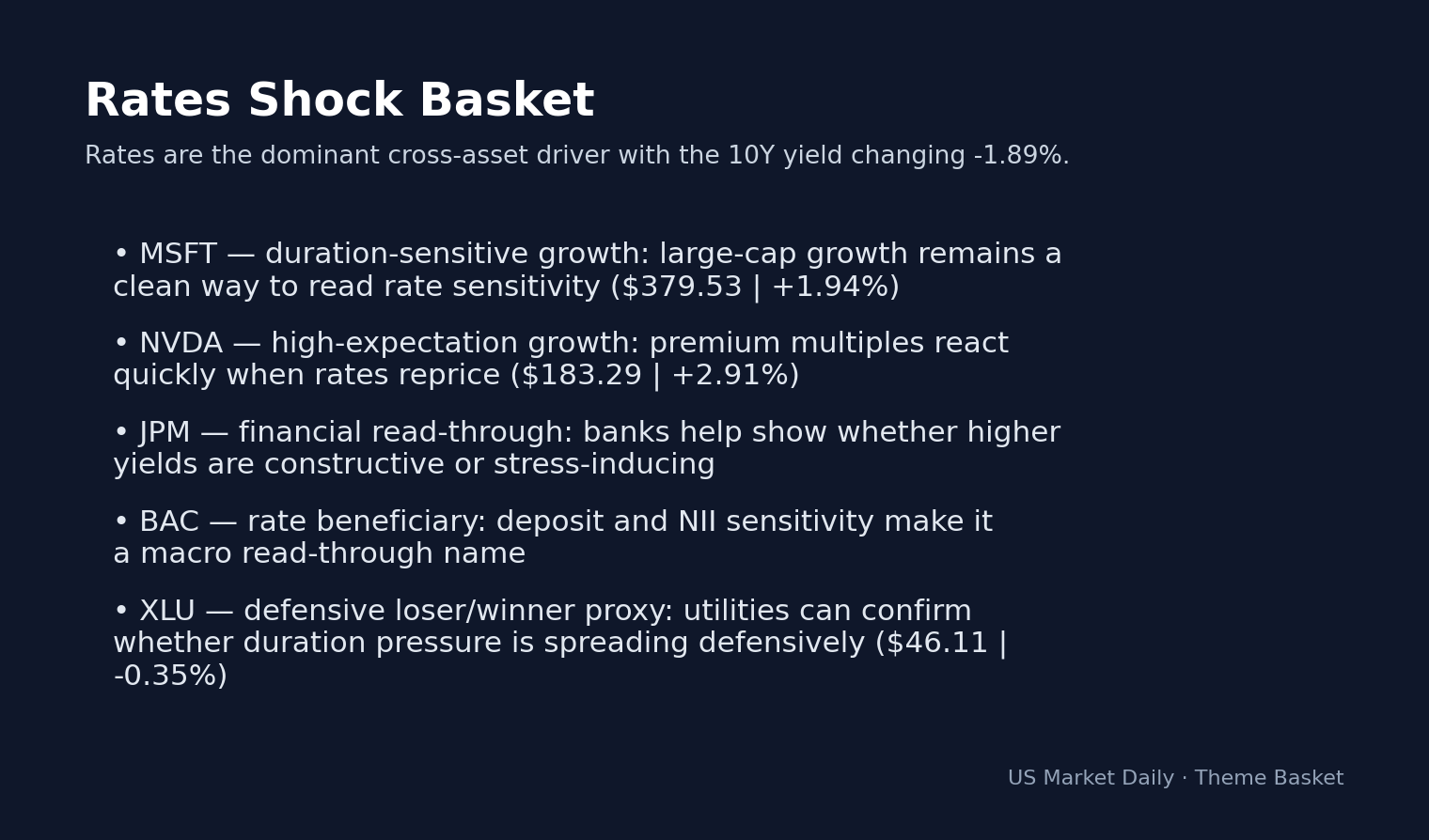
What this means: Rates are the dominant cross-asset driver with the 10Y yield changing -1.89%.
What’s already priced in: options are implying roughly 3.47% moves around key events; GOOGL is carrying one of the largest event bars in the tape
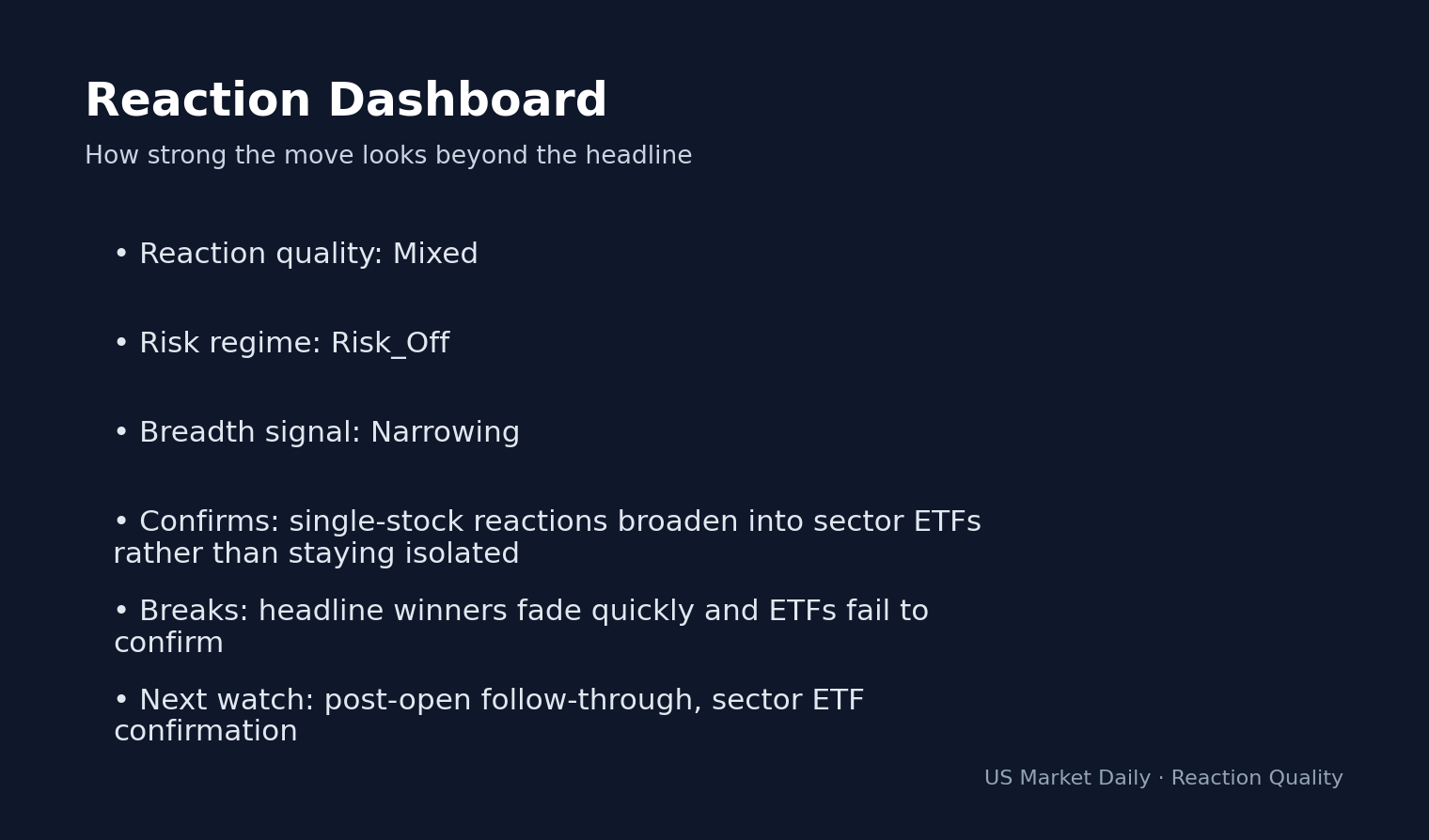
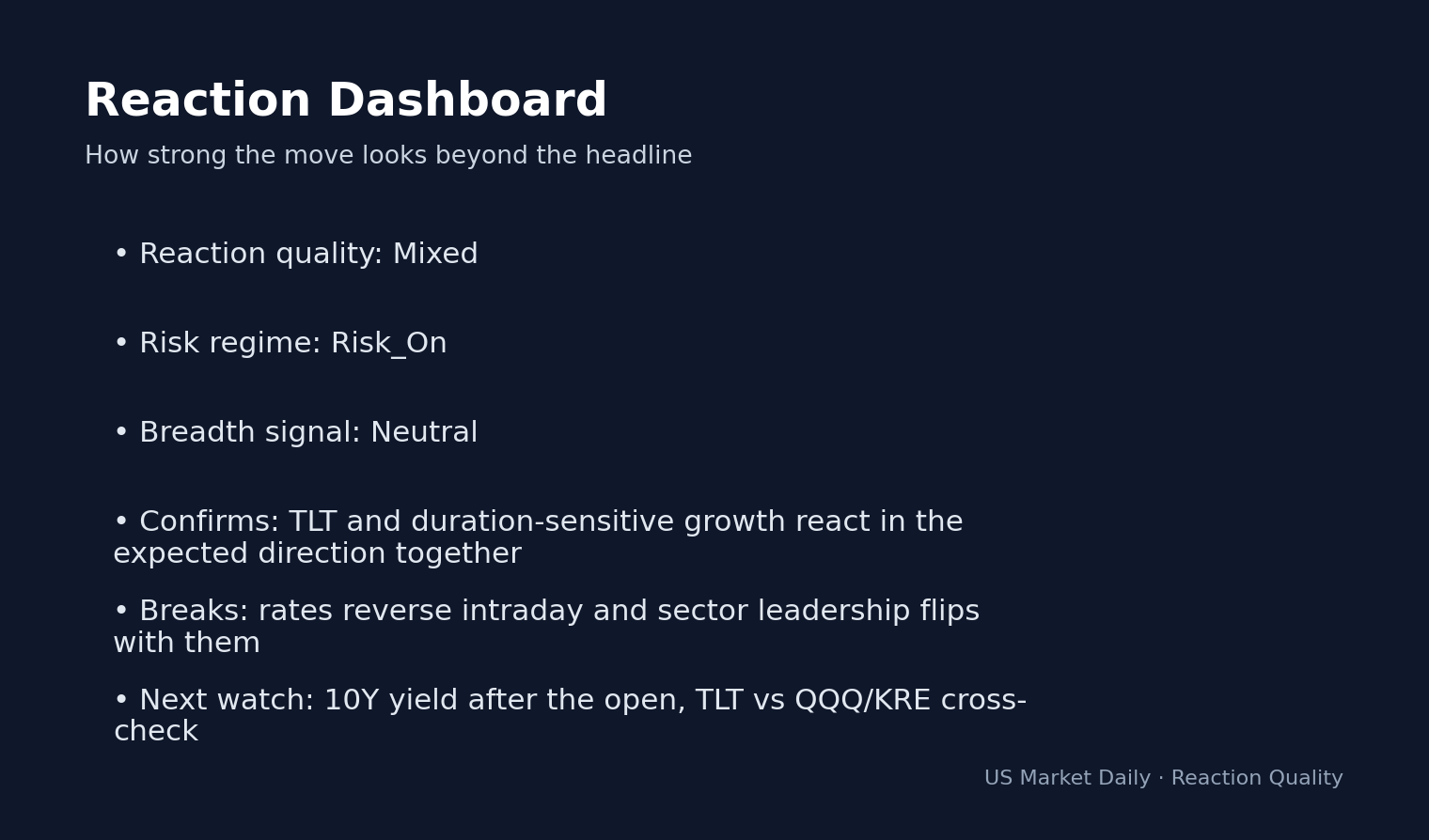
Reaction quality: Mixed confirmation
Stocks tied to this theme
- MSFT — duration-sensitive growth. large-cap growth remains a clean way to read rate sensitivity Recent action: $379.53 | +1.94%.
- NVDA — high-expectation growth. premium multiples react quickly when rates reprice Recent action: $183.29 | +2.91%.
- JPM — financial read-through. banks help show whether higher yields are constructive or stress-inducing
- BAC — rate beneficiary. deposit and NII sensitivity make it a macro read-through name
- XLU — defensive loser/winner proxy. utilities can confirm whether duration pressure is spreading defensively Recent action: $46.11 | -0.35%.
Theme map
Theme map split into direct winners, second-order confirmations, crowded names, lagging names, and false friends to avoid ticker dumping.
Direct winners
- BAC — rate beneficiary. deposit and NII sensitivity make it a macro read-through name
- XLU — defensive loser/winner proxy. utilities can confirm whether duration pressure is spreading defensively Recent action: $46.11 | -0.35%.
Second-order beneficiaries
- JPM — financial read-through. banks help show whether higher yields are constructive or stress-inducing
Crowded names
- NVDA — high-expectation growth. premium multiples react quickly when rates reprice Recent action: $183.29 | +2.91%.
Lagging names to watch
- XLU — defensive loser/winner proxy. utilities can confirm whether duration pressure is spreading defensively Recent action: $46.11 | -0.35%.
False friends
- XLU — duration proxy. utilities react to rates, but they do not confirm whether the move is growth-friendly or stress-driven Recent action: $46.11 | -0.35%.
- AAPL — mega-cap passenger. can move with rates without saying much about broader macro transmission Recent action: $258.65 | +2.03%.
ETFs and market gauges to watch
- TLT — duration ETF. shows whether rates are truly easing or tightening
- IWM — cyclical sensitivity. small caps can confirm if lower yields are broadening risk appetite
- KRE — regional bank proxy. helps distinguish benign from stressful yield moves
What confirms the move
- TLT and duration-sensitive growth react in the expected direction together
- banks confirm whether the yield move is constructive or stressful
- small caps participate if lower yields are genuinely easing financial conditions
What would prove it wrong
- rates reverse intraday and sector leadership flips with them
- financials and small caps fail to confirm the move
Look smart tomorrow
- 10Y yield after the open
- TLT vs QQQ/KRE cross-check
- regional bank reaction
Playbook Memory
Internal reference notes from similar setups already covered on the site.
What this setup has looked like on this site: Rates Shock playbook memory from 18 site examples | common sections: Recent internal echoes, What confirms the reaction, What breaks the reaction
Memory strength: strong | Tracked examples: 18 | Rewrite candidates: 0 | Refresh candidates: 0
Sections that usually mattered
- Recent internal echoes
- What confirms the reaction
- What breaks the reaction
- Historical watchpoints for this setup
Checks this setup usually needs
- Usual confirmation focus: TLT and duration-sensitive growth react in the expected direction together
- Usual failure mode: rates reverse intraday and sector leadership flips with them
- Current follow-through state: developing
Recent internal echoes
- Stock Market, Mar 31, 2026: VIX Drops 2.16% to 30.38 as Rate Relief Meets
- Stock Market, Mar 31, 2026: VIX Drops 2.16% to 30.38 as Rate Relief Meets Fear
- Stock Market, Mar 31, 2026: VIX Falls 2.32% to 30.33 But Fear Remains Elevated Preview
- Stock Market, Mar 31, 2026: VIX Falls to 30.26 as Rate Relief Meets Defensive Preview
Tomorrow’s Playbook
Keep this one open if you want the forward-looking levels, confirms, and invalidation checklist.
Summary: Tomorrow's playbook for Rates Shock: Rates are the dominant cross-asset driver with the 10Y yield changing -1.89%. The opening check is whether confirmation broadens fast enough to overcome the risk that the headline fades once cash-session liquidity resets the tape.
Base case: treat the setup as developing and let the first hour decide whether the theme broadens or stalls.
Risk regime: risk-on | Breadth: neutral | Follow-through: developing
Opening 30-Minute Checks
- Watch whether rates shock leaders hold the opening range in the first 30 minutes.
- Cross-check the opening range and whether leadership broadens against breadth (neutral) rather than the index alone.
- Treat an unresolved reaction with developing follow-through as tentative until volume and ETFs confirm.
- If credit, semis, and small caps broaden with the move, the opening tape is more likely to stick.
Key Levels to Watch
- the opening range and whether leadership broadens
- 10Y yield around 4.26% as the rates cross-check.
- VIX around 20.19 as the volatility confirmation level.
If / Then Framework
- If tlt and duration-sensitive growth react in the expected direction together, the market can keep leaning into rates shock.
- If rates reverse intraday and sector leadership flips with them, downgrade the move to a headline reaction rather than a durable regime shift.
- If options are implying roughly 3.47% moves around key events; GOOGL is carrying one of the largest event bars in the tape, focus on laggards and breadth instead of chasing the first winner.
What Confirms the Move
- TLT and duration-sensitive growth react in the expected direction together
- banks confirm whether the yield move is constructive or stressful
What Invalidates the Move
- rates reverse intraday and sector leadership flips with them
- financials and small caps fail to confirm the move
- Volume is concentrated in one name, which makes the move look less broadly owned.
Next-Session Checklist
- 10Y yield after the open
- TLT vs QQQ/KRE cross-check
- regional bank reaction
- TLT direction vs QQQ/IWM
- Check whether second-order beneficiaries participate, not just the obvious leaders.
Options Interpretation / Sector / Industry Dispersion / Data Freshness
Supporting signals for readers who want the deeper tape, options, and breadth context.
Options Interpretation
Summary: implied moves are moderate; IV premium is cheap; skew is balanced; term structure is flat; OI positioning looks upside-chasing.
Regimes: implied move moderate | IV premium cheap | skew balanced | OI positioning upside-chasing | term structure flat.
Sector / Industry Dispersion
Wide Dispersion with broadly constructive breadth, selective participation under the surface, and a leader/laggard spread of 8.85 percentage points.
Rotation / participation profile
- Rotation state: offense leading
- Style tilt: growth leadership
- Cyclicals vs defensives: +0.86 pts
- Growth vs value: +2.03 pts
Dispersion leaders
- XLI: +3.72%
- XLY: +3.56%
- XLK: +3.43%
Dispersion laggards
- XLP: +0.58%
- XLU: -0.35%
- XLE: -5.13%
Data Freshness
Data is fresh for the market_hours tape with 3/6 source buckets populated; session alignment is aligned and intraday readiness is ready.
Session / freshness profile
- Market phase: market_hours
- Expected window: market_hours
- Session alignment: aligned
- Intraday readiness: ready
- Overnight carry: acceptable
Driver Profile Monitor
- GS: drivers investment banking recovery, trading revenue; watch IB fees, FICC trading
- JPM: drivers net interest income, credit quality; watch NII guidance, charge-offs
- BAC: drivers net interest income, deposit pricing; watch NII guidance, deposit beta
- AAPL: drivers iPhone replacement cycle, China demand; watch services growth, Greater China revenue
Three Numbers That Matter
A compact frame for the three readings most worth carrying into the next session.
Three Numbers That Matter
- 10Y yield: 4.26% — Higher yields usually tighten the leash on long-duration growth and small-cap risk appetite.
- VIX: 20.19 — Volatility tells you whether the tape is confirming risk-taking or fading it.
- WTI crude: $93.84 — Crude often decides whether the theme stays isolated or spills into broader inflation and risk sentiment.
What’s Different This Time
- This time the market is dealing with a Rates Shock setup rather than a generic macro headline.
- Cross-asset signals lean risk-on, which gives the theme a better shot at broadening beyond first-order winners.
Data sources: Yahoo Finance · SEC EDGAR
This article is for informational purposes only and does not constitute financial advice. Always do your own research before making investment decisions.