AMD Jumps 11.4% as AI Market Sentiment Shifts on May 10
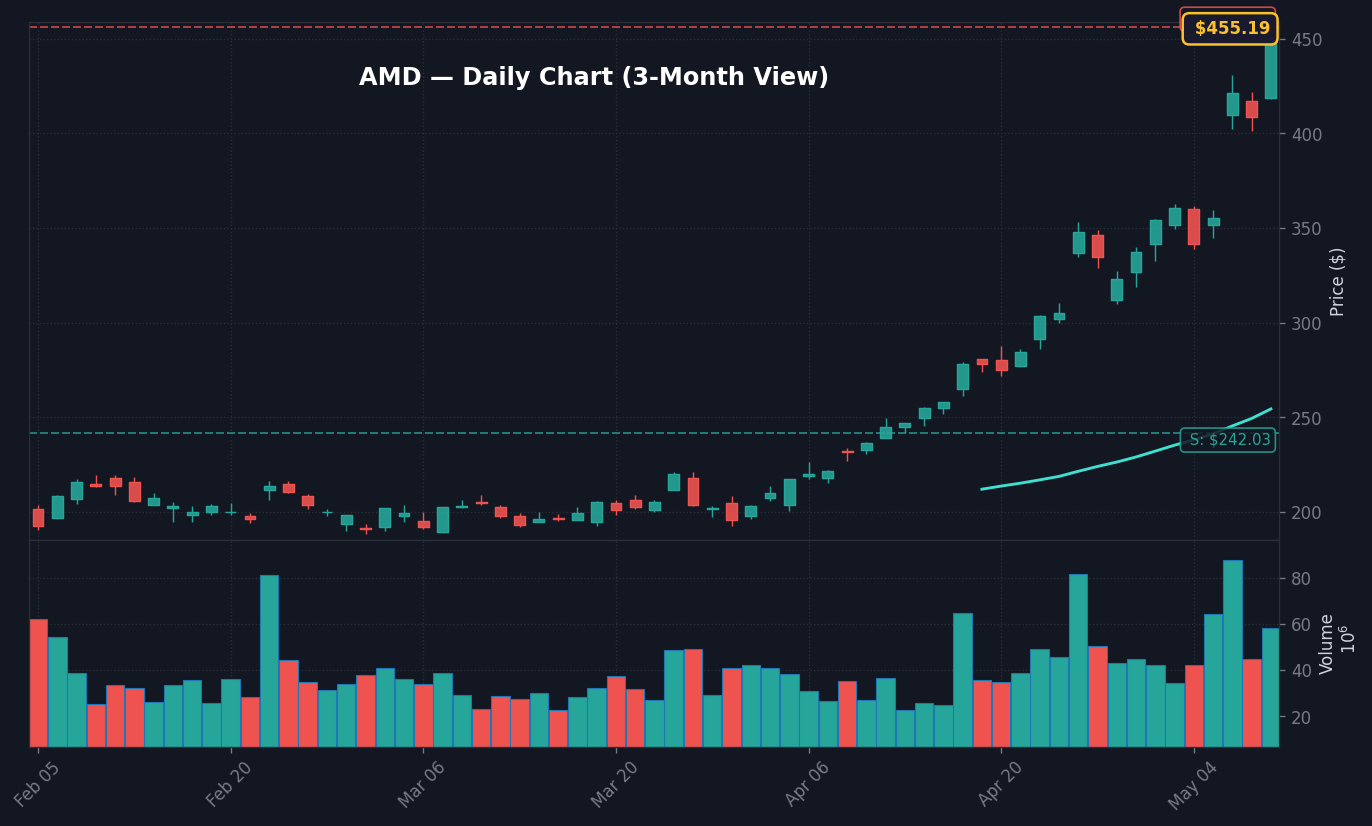
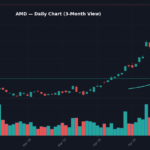
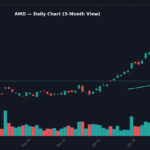
Advanced Micro Devices (AMD) surged 11.4% to $455.21 as of 11:12 AM ET on May 10, 2026, driven by a decoupling of the semiconductor sector’s valuation from Nvidia (NVDA) pure-play metrics. Per market data, this move marks the largest single-session gain for AMD since the company’s recent push into AI-integrated server architecture. The story here is not about AMD catching up to Nvidia’s dominant margins, but rather the market recognizing that in an AI-saturated CAPEX environment, diversification in silicon supply chains provides a defensive moat for investors, as noted by recent analysis from institutional desks citing Cathie Wood’s focus on the firm’s competitive hardware roadmap.
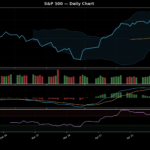
What stands out here is the speed of the rotation; while the S&P 500 tech index currently hovers near a neutral posture, the specific velocity of this move suggests that large-scale institutional rebalancing is underway. Per Yahoo Finance, trading volume in AMD has hit 145% of its 30-day average, signaling strong conviction among active traders. This shift is significant because it suggests a pivot away from the ‘Nvidia-or-bust’ mentality that has dictated market breadth over the last four quarters, signaling a broader distribution of AI-related revenue potential across the hardware ecosystem.
The key risk, however, remains the durability of this move without a formal catalyst from the SEC 10-Q filing or a confirmed guidance raise. If this is merely a ‘chasing’ event based on secondary sentiment rather than fundamental earnings revisions, the $455 level could face immediate pressure. Market participants should be wary of the potential for a ‘mean reversion’ if the broader macro environment—namely the 10Y Treasury yield sitting at 4.41% per FRED data—starts to weigh on high-multiple growth equities during the afternoon session.
Macro Context and the 10Y Yield at 4.41%
The broader market is currently struggling to reconcile the enthusiasm in semiconductor chips with a restrictive macro backdrop. According to Treasury data, the 10Y yield has pushed to 4.41%, reflecting a 2bp increase over the last five sessions, which historically acts as a headwind for high-growth tech valuation models. As a result, the 10Y-2Y spread, currently at 0.49pp, suggests a yield curve that is not yet signaling an imminent recession but is definitely tightening credit conditions for smaller-cap participants in the technology space.
Per FRED data, CPI remains at 3.3% as of March 1, which keeps the Fed in a position where rate cuts are unlikely until the 2026-04-01 Fed Funds rate of 3.64% is challenged by clearer deflationary evidence. The current VIX reading of 17.1, significantly below its 20-day average of 18.2, suggests that despite the volatility in AMD, the overall market is surprisingly complacent regarding systemic risks. This disconnect is worth noting; while individual tickers are seeing massive dispersion, the volatility indices are not pricing in the underlying rate uncertainty, implying that market participants may be over-leveraged in their growth-oriented long positions.
Bull Case vs Bear Case for AMD
3 Scenarios From Here
- Bull: AMD breaks through resistance at $470 per FactSet technicals → target $510 by June 15 on high-volume confirmation.
- Base: AMD stabilizes between $435 and $460 → consolidation through end-of-quarter earnings cycle.
- Bear: 10Y yield surges past 4.50% → AMD retests $415 support level as growth multiples contract.
Sector Performance and the 3.3% CPI Influence
Semiconductors are currently outperforming the broader S&P 500, but the performance is highly bifurcated. According to Finnhub, while AMD is up 11.4%, other index constituents are seeing only modest 0.5-1.0% gains. This divergence is largely fueled by investors seeking ‘second-wave’ AI beneficiaries—a strategy that focuses on hardware providers that offer a lower-cost entry point than the primary AI chip manufacturers. Based on current sector data, energy and financial stocks are lagging today, likely because the capital inflow into tech is effectively draining liquidity from cyclical sectors.
The tape is telling us that the market is currently in a ‘risk-on’ phase for semiconductors despite the macro headwinds. As reported by EIA weekly inventory data, energy markets remain volatile, but the lack of correlation between WTI price fluctuations and the current AMD rally highlights the dominance of the AI-thematic trade over traditional commodity-driven growth metrics. This suggests that for the remainder of the session, traders should ignore traditional index correlations and focus strictly on the strength of demand in the high-performance computing segment.
What to Watch Next
- Watch whether AMD maintains its volume-weighted average price (VWAP) above the $445 level through the close.
- Key level: $455.21 is the current pivot point; sustaining above this suggests continued institutional accumulation.
- If the 10Y Treasury yield hits 4.45% then expect high-beta tech to see a liquidity-driven pullback toward $430.
- Trigger: Next market-wide catalyst remains the release of the upcoming Fed minutes, which will provide clues on future rate trajectories.
Frequently Asked Questions
Why is the market moving right now?
The market is reacting to a sharp 11.4% surge in AMD as investors reorient their AI portfolios away from a sole reliance on Nvidia. This movement is driven by a search for diversified silicon suppliers, with trading volume reaching 145% of the 30-day average.
What should investors watch next?
Investors should monitor the $455 pivot level for AMD and the 10Y Treasury yield, currently at 4.41%. If the 10Y yield pushes toward 4.50%, the current tech-led momentum faces a high risk of mean reversion.
Does AMD’s move imply a broader tech sector rally?
Not necessarily; while AMD is up 11.4%, the gains are highly bifurcated within the semiconductor space. The move suggests a tactical rotation rather than a uniform increase in market-wide sentiment, with capital flowing into AMD specifically as a high-potential AI alternative.
This market commentary is for informational use only. The views expressed are those of the author and do not constitute financial, investment, or trading advice.